How to Build an AI Deal Sourcing Agent for VC (2026)
How to build an AI deal sourcing agent that sees companies before the round is announced: thesis filters, hiring signals, stealth founders, and webhooks.
Venture funds still hire people whose entire job is sourcing. One New York seed firm describes the seat plainly: be out in the ecosystem, chase themes, and meet the next great founder before anyone else does. That sentence is the bar an agent has to clear.
An agent does not replace that seat. It arms it, by covering the part of the market no network reaches and flagging companies while they are still cheap to see early.
This guide covers how to build an AI deal sourcing agent that is actually early: the signals that fire before a round, thesis filters, stealth founders, and the point where the agent must stop.
Key Takeaways#
- Announced rounds are the latest signal and the most crowded list. Early lives in hiring and people data.
- A thesis becomes an engine when it is encoded as filters an agent reruns daily.
- Stealth founders appear in people data months before any directory lists a company.
- The agent fills and ranks the pipeline. Partners judge, meet, and decide.
What Is an AI Deal Sourcing Agent?#
An AI deal sourcing agent is software that scans company, funding, and people data against an investment thesis and surfaces a ranked pipeline of companies worth a partner's attention. It does the top-of-funnel scanning a junior investor does manually, continuously, across far more of the market.
The output is coverage, not conviction. The agent guarantees that companies matching the thesis get seen. Whether any of them deserves a term sheet remains a human question, and the best builds are honest about that split.
Why Is Announced Funding Always Late?#
An announced round is late by definition: by the time it is public, every fund with a news alert has the same company on the same list, and the winners were talking to the founder months earlier. An agent that watches press releases automates being late.
Buyers in the acquisition world draw the line cleanly: brokered deal flow is the listings every buyer can see, proprietary deal flow is won on lists, research, and catching an owner at the right moment, and it is where the better terms live. Practitioners running high-volume acquisition shops credit proprietary sourcing engines, not announcement feeds, for the deals that never touch a competitive process. Deal people compress it further: a pipeline proves the machine behind it, the sourcing, the criteria, and the discipline to pass.
The same logic runs in venture. The edge is not reading the news faster. It is seeing the company before there is news.
What a Deal Sourcing Agent Is NOT#
Three tools sit near this category and do a different job. A deal sourcing agent is not a startup directory with alerts, not a deal CRM, and not a judgment model. Knowing the borders keeps a firm from buying one thing while expecting another.
Not a directory. Crunchbase and PitchBook are research tools built for a human looking up companies that are already visible. They are strong on funding history, and they list a company after the world can see it. We wrote a full review of the Crunchbase API on exactly this line.
Not a deal CRM. Affinity and similar tools organize the relationships and pipeline a firm already has. The agent's job starts one step earlier: putting companies into that pipeline that nobody at the firm had met.
Not a judgment model. No scoring function can assess a founder's quality from structured fields. The agent ranks reading order. Anyone selling it as automated conviction is selling past what the data can do.
How Do You Catch a Stealth Founder?#
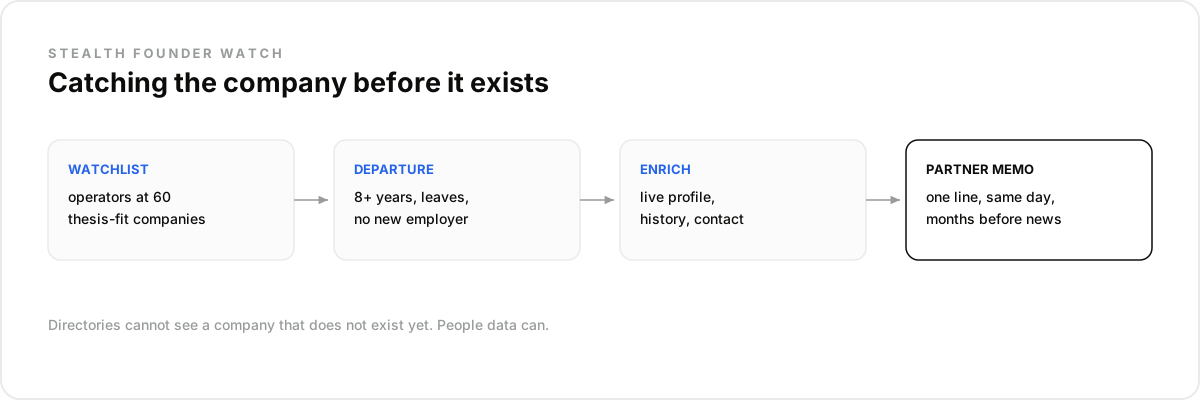
You catch a stealth founder in people data, by watching credible operators leave strong companies with nothing announced next. A company in stealth has no domain, no page, no press. The founder is the only observable object, and their move is the whole signal.
It is the earliest signal there is, and the most proprietary. Hiring spikes and growth fields move before a round, but founder movement moves before the company. Directories cannot see it, because there is nothing to list yet. People data can.
A concrete build: one deal-sourcing team watches senior product and engineering leaders across a list of roughly sixty companies, the Stripes and Ramps of their thesis. The agent flags anyone with eight-plus years of experience whose profile shows a departure and no new employer, then enriches the profile and drafts a one-line memo for the partner channel.
The filters behind that are ordinary people-search filters: past_company, years_of_experience, is_currently_employed. What makes it deal sourcing is running them on a schedule against live records, through a data layer built for VC agents.
How Do You Encode a Thesis as Filters?#
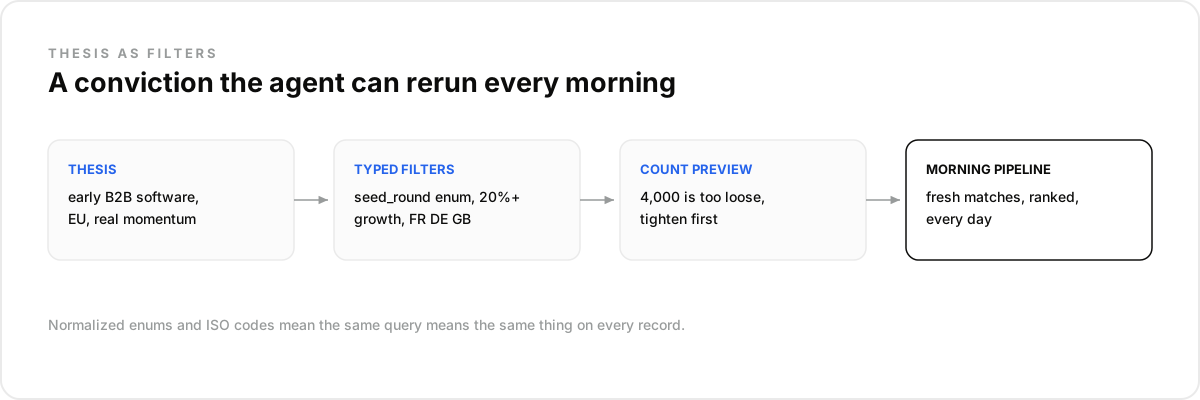
You encode a thesis by translating each conviction into a queryable condition: stage becomes a funding filter, momentum becomes a growth threshold, geography becomes country codes. The result is a search the agent can rerun every morning, which is what turns a thesis into coverage.
Say the thesis is early-stage European B2B software with real hiring momentum:
import requests

response = requests.post(
    "https://api.dataforb2b.ai/search/companies",
    headers={"api_key": "YOUR_api_key", "Content-Type": "application/json"},
    json={
        "filters": {
            "op": "and",
            "conditions": [
                {"column": "funding_stage_normalized", "type": "in",
                 "value": ["pre_seed_round", "seed_round"]},
                {"column": "employee_growth_6m", "type": ">", "value": 20},
                {"column": "country_iso_code", "type": "in", "value": ["FR", "DE", "GB"]},
                {"column": "founded_year", "type": ">=", "value": 2024}
            ]
        },
        "count": 50
    }
)

pipeline = response.json()["results"]
Two details matter more than they look. The funding stage enum is normalized, so seed_round means the same thing on every record. And country codes are ISO, GB rather than UK, the kind of trap that silently empties a result set.
Before running wide, a count endpoint estimates how many companies match, so a thesis that would return four thousand names gets tightened before it floods anyone.
Thesis filters run against 75M+ companies on the live API. Start on the free tier via the pricing page.
When Do Webhooks Close the Loop?#
Webhooks close the loop once the agent has something worth watching: the founders it flagged, the companies matching the thesis, the accounts partners asked about. A monitor on funding and founder-move signals turns those watchlists into events, pushed to the agent the moment something happens.
The difference with a news alert is context. When a watched founder's new company eventually raises, the event arrives attached to the history the firm already holds: who they are, when they left, who took the first look. That is a warm memo, not a headline everyone else got.
Should You Trust the Agent's Scoring?#
Trust it as a reading order and nothing more. A transparent score built from growth, stage fit, and founder history tells a partner what to open first. The moment a score gets treated as conviction, the pipeline stops being sourced and starts being outsourced.
Best for: funds running a thesis wide enough that coverage beats network alone, and teams building deal-sourcing products for them. Not for: a three-partner firm doing five warm-intro deals a year. Their bottleneck is judgment time, not pipeline volume.
The objection worth pre-empting: will this flood partners with noise? Only if scoring is opaque and thresholds are loose. A tight thesis, a visible score, and a weekly cap on flagged companies keep the pipeline scannable, and the count estimate sizes it before anything runs.
The Mistake Most Firms Make#
The mistake most teams make is building the agent on company data alone. Company records describe what already exists publicly, so the pipeline fills with firms everyone can see, ranked slightly faster. The genuinely early signals live in people data, and most builds skip it entirely.
What surprised us across these builds is how consistently the differentiated deals traced back to a person: a founder move, a hiring pattern, a cluster of operators leaving the same space. In our experience, a deal sourcing agent without people data is a news reader with filters.
A data layer like DataForB2B exposes companies, people, and funding signals through one API, over REST, MCP, and webhooks, which is what lets a single agent watch firms and founders together.
How Do You Run This Pipeline in Claude or Any LLM Agent?#
The thesis query, the stealth-founder watch, and the enrichment pass all run as one Claude conversation before anyone writes integration code. Connect the data layer over MCP and the pipeline becomes a brief you type once and then schedule.
- Create a free account at app.dataforb2b.ai/signup and grab your API key.
- In Claude, open Settings, then Connectors, and add https://mcp.dataforb2b.ai/mcp. The same server plugs into Cursor, VS Code, ChatGPT, or any MCP-enabled agent.
- Paste the brief: "Find pre-seed and seed B2B software companies in FR, DE and GB with 6-month headcount growth above 20, and enrich the founders."
- Turn the working chat into a scheduled routine so it runs every morning without you.
Frequently asked questions
- How is this different from a Crunchbase alert?
- An alert tells you a directory updated, which usually means the news is already public. A sourcing agent queries live company and people data on its own schedule, catches pre-announcement signals like hiring spikes and founder moves, and receives events by webhook instead of polling.
- What does a funding webhook actually deliver?
- An event payload the moment a watched signal fires: the signal type, the target company or profile, and the event data, delivered to your endpoint with a signed header and automatic retries. The agent reacts in minutes instead of checking a directory on a schedule.
- Can the same agent work for corporate development or PE?
- Yes. The architecture is identical: encode the acquisition thesis as filters, watch growth and hiring signals, monitor operators in the target space. Only the thesis changes. High-volume acquirers already run this playbook, and their proprietary pipelines are proof that it compounds.
- How many companies should a daily thesis query return?
- Few enough that a human actually reads them. In practice teams aim for a daily handful plus a weekly digest, tuned with a count estimate before the query runs wide. A pipeline nobody reads is coverage in name only, and it erodes trust fast.
- Does the agent need funding data at all?
- Yes, but as confirmation and context rather than discovery. Stage filters keep the thesis honest, funding history frames a company's trajectory, and a funding webhook confirms a flagged company is progressing. Discovery itself comes earlier, from hiring and founder signals.