Explorium Alternative: Pricing, Coverage, and Fit (2026)
Looking for an Explorium alternative? Credit packs vs monthly plans, a public coverage benchmark, and which request-time B2B data API fits agents in 2026.
An agent pipeline stops mid-run on a Tuesday. Nothing is down. The credit pack just hit zero, and with it the whole data layer, until someone buys the next pack.
That failure mode is specific to how Explorium sells: one-time credit packs instead of subscriptions. Packs are non-refundable, expire after 12 months, and do not refill monthly. It is a deliberate model with real advantages, and real consequences for anyone comparing an Explorium alternative for a product that queries every day.
There is also a data question. In the one public benchmark that hand-verified its ground truth, Explorium came last of eight providers on field coverage.
This guide covers the pack economics, the benchmark, what AgentSource can and cannot search, and when a per-operation API fits better.
Key Takeaways#
- Packs, not plans. Explorium sells one-time credit packs from $99.99 for 2,500 credits; they expire in 12 months, are non-refundable, and the service stops at zero.
- Coverage has a public data point. openbenchmarks.com measured 75.96% field coverage, the lowest of the eight providers tested.
- Search shapes differ. AgentSource has no job-postings search and no posts search; search preview is reserved for custom plans.
- Per-record math favors fractional credits. Enrichments run 1 to 5 credits at $0.04 each entry-tier; a cached record here costs 0.75 credits, about $0.012.
What Is Explorium AgentSource?#
Explorium AgentSource is a B2B data API and MCP server that matches, filters, and enriches businesses and prospects, with 30+ enrichment types and push webhooks for events like funding rounds and job changes. The company claims 150M+ company profiles and 800M+ professional profiles from 50+ sources.
It started as a data-science enrichment platform and repositioned hard toward GTM agents; the content engine behind that pivot ships at high velocity.
The MCP story is real. There is a hosted server, a Vibe Prospecting agent for no-code use, and active content pushing the agent-native angle. Events cover a wide span, from funding rounds to office closings and lawsuits.
Two details worth knowing before you compare. Some signals are partner-sourced and named as such in the docs: lookalike companies come from Ocean.io, intent topics from Bombora. And the search surface is businesses and prospects only, which the sections below unpack.
How Does Explorium Pricing Work?#
Explorium sells one-time credit packs, not subscriptions: a free trial with 100 credits, then $99.99 for 2,500 credits, $749.99 for 25,000, and $7,499.99 for 500,000, with custom enterprise above. Per credit that is $0.04 at entry, falling to $0.015 at the top pack.
The rules around the packs shape the experience:
- Credits expire 12 months after purchase and do not roll over. Trial credits last 90 days.
- Packs are non-refundable and do not renew automatically.
- When the balance hits zero, the service stops until you buy again. An optional auto-refill can re-buy for you.
- Search preview, checking availability before spending, is reserved for custom plans.
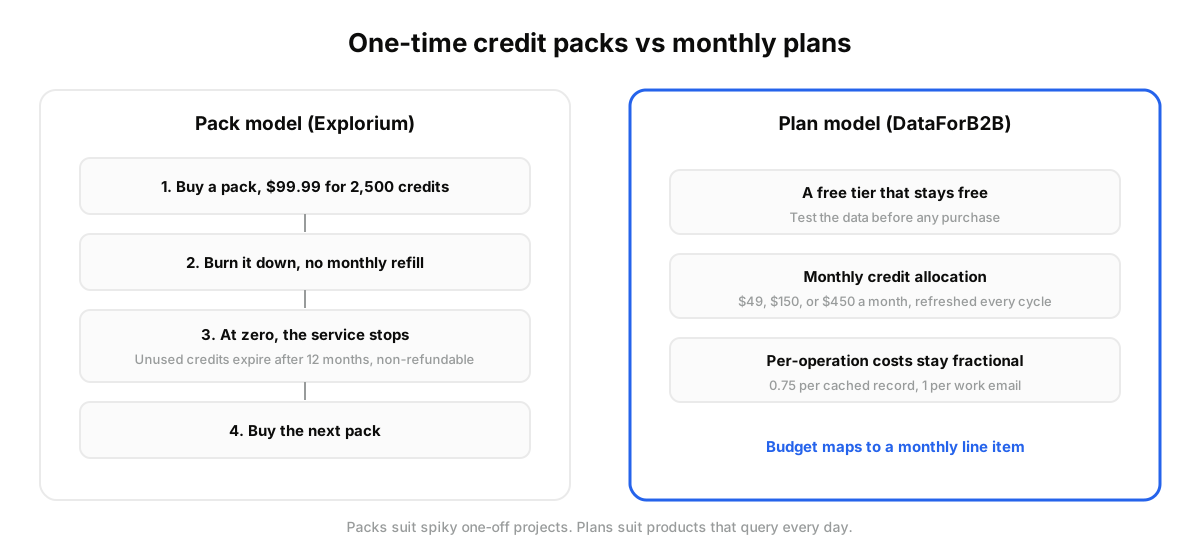
Enrichments cost 1 to 5 credits per record, so an entry-tier record runs $0.04 to $0.20. Per-operation pricing lands lower: a cached profile record costs 0.75 credits, about $0.012 on the $49 plan, and a verified work email 1 credit.
Neither model is wrong. Packs suit spiky, one-off enrichment projects. A product that queries daily usually wants an allocation that refreshes monthly and a floor that never disappears.
What Does the Coverage Benchmark Say?#
One public benchmark exists with hand-verified ground truth: openbenchmarks.com tested eight enrichment providers against 282 companies whose reference fields were manually checked against live sources. Explorium resolved 95.04% of domains but returned 75.96% field coverage, the lowest of the eight tested.
The benchmark's own headline finding gives useful context: every provider tested resolved between 94.7% and 100% of domains, so resolution rate alone is not a buying signal anymore. Coverage and latency are where the eight actually separated, with latency spanning a 78x range across vendors.
Read that carefully rather than triumphantly. Resolution in the mid-nineties means the matching works. Coverage last of eight means returned records more often had empty fields than any other provider in the cohort. Latency, 616ms at the median, was fine.
And one benchmark is one cohort. The only coverage number that matters is the one on your ICP. Run 50 of your own records through any provider before believing a chart, including ours.
Which Questions Can Each API Answer?#
AgentSource searches two entities: businesses and prospects. There is no job-postings search and no social-posts search in the catalog; hiring shows up as department-trend events, and social presence as an enrichment on the company record. If your agent's questions live inside match, fetch, and enrich, that surface is enough.
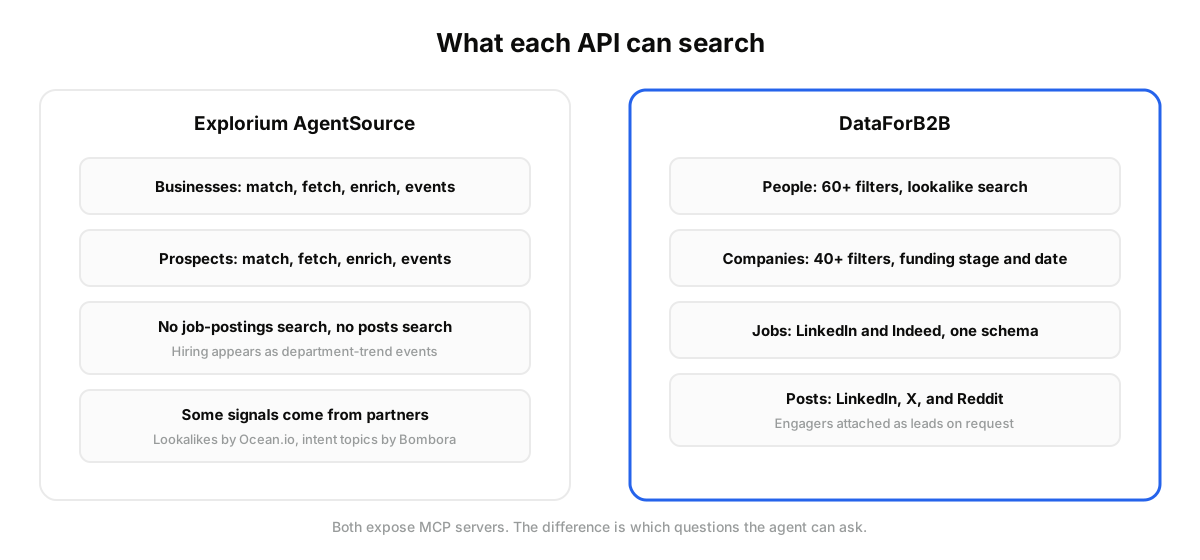
The search surface here is wider: people on 60+ filters with lookalike search, companies on 40+ filters including funding stage and date, job postings from LinkedIn and Indeed on one schema, and posts across LinkedIn, X, and Reddit with engagers attached as leads.
What the wider surface unlocks, by vertical:
- A sales tool turns "companies hiring SDRs right now" into a query, then finds the decision-maker at each match.
- A GTM agent reads Reddit and X threads where buyers ask for tools, and treats the authors as inbound-grade leads.
- A deal-sourcing agent filters companies that raised a series_a in the last 90 days, by industry and headcount.
When Is DataForB2B the Better Fit?#
It fits when the product queries daily and the questions go beyond match-and-enrich. Monthly plans from $49 with a permanent free tier, fractional per-operation credits, search across people, companies, jobs, and posts, and contact enrichment included on every plan, with no preview gate on search.
A concrete case. A founder building a recruiting agent needs "engineering teams that just got funding and are hiring" as a live query, plus verified emails for shortlisted candidates. That is three searches and an enrichment chained on one API, a few credits per candidate surfaced, inside the entry plan while the product finds its first customers on the free tier.
The honest boundary: there is no technographics bundle here, no intent-topics feed, and no website-traffic enrichment. If those signals drive your model, the comparison tilts back.
Where Explorium Is the Stronger Pick#
Pick Explorium when enrichment breadth is the job. Thirty-plus signal types on one credit pool is a real advantage for teams scoring accounts on technographics, intent, website traffic, and financial metrics together, and volume discounts aggregate across all of them.
The pack model also fits one-off projects well: enrich a database once, pay once, no subscription to cancel. And for non-technical users, the Vibe Prospecting agent is a genuinely low-friction way in.
How Do You Compare Them From Claude?#
Both expose MCP servers, so the cleanest test is the same prompts through both, watching coverage on your ICP and credits burned.
- Create a free account at app.dataforb2b.ai/signup. The free tier does not expire into a paid wall.
- Connect the MCP server in Claude: Settings, then Connectors, then add mcp.dataforb2b.ai/mcp. It works the same in Cursor, VS Code, ChatGPT, and custom agents.
- Paste a prompt that tests the surface gap: "Find 20 fintech companies that raised in the last quarter and are hiring backend engineers, and give me the head of engineering at each with a verified work email."
- Schedule it as a routine and compare a week of answers side by side.
We ran the same exercise for Coresignal and Crustdata if you are mapping the whole category.
If your agent asks questions a match-and-enrich surface cannot answer, start on the free tier and run the side-by-side above. The rest is on the pricing page.
Frequently asked questions
- How much does Explorium cost?
- Explorium sells one-time credit packs: a free trial with 100 credits, then $99.99 for 2,500 credits, $749.99 for 25,000, and $7,499.99 for 500,000, with custom enterprise pricing above. Enrichments cost 1 to 5 credits per record. Packs are non-refundable and there is no subscription tier.
- What is the best Explorium alternative for AI agents?
- For products that query B2B data daily, DataForB2B is the closest fit: monthly plans from $49 with a permanent free tier, fractional per-operation credits, and search across people, companies, jobs, and posts. Explorium remains strong when you want many enrichment types drawn from one credit pool.
- Do Explorium credits expire?
- Yes. Paid credits expire 12 months after purchase and cannot be rolled over; packs are non-refundable and do not renew automatically. When the balance hits zero the service stops until you buy again, unless the optional auto-refill is enabled. Free trial credits last 90 days.
- Does Explorium have a free trial?
- Yes, a free account comes with 100 credits, valid for 90 days, with no sales call required. It is a trial rather than an ongoing free tier: once the credits are used or expired, you move to a paid pack. Plan for that when you scope a proof of concept.
- What is the difference between Explorium and DataForB2B?
- Both are MCP-native B2B data APIs. Explorium centers on enrichment breadth, 30+ signal types across businesses and prospects, sold as one-time credit packs. DataForB2B centers on request-time search across people, companies, jobs, and posts, with contact enrichment included, sold as monthly plans with a free tier.