Best Coresignal Alternatives 2026: Pricing, Credits & Fit
Looking for a Coresignal alternative? Real 2026 pricing, the credit math per record, and when a per-operation B2B data API is the better fit for agents.
Most builders comparing a Coresignal alternative start with the wrong number. The plan price is not the price. The credit cost per record is.
Coresignal's entry plan looks cheap at $49 a month. Then you read the credit table: collecting one profile record costs 10 to 20 credits, and contact enrichment does not unlock until the $499 plan. The 2,500 credits on that entry plan buy about 250 basic records.
None of that makes Coresignal a bad product. It makes it a product with a specific shape: large datasets, multi-source aggregation, bulk collection. If your agent queries data at request time instead of ingesting copies of it, the shape matters more than the sticker.
This guide covers the real 2026 pricing, the credit math per record, and when each shape wins.
Key Takeaways#
- The credit table is the real price list. Coresignal plans run $49 to $5,000 a month, and collecting one record costs 10 to 20 credits.
- Contact data has a plan floor. Contact enrichment and search preview unlock from the $499 Pro plan.
- Entry-tier math favors per-operation credits. About $0.20 to $0.39 per profile record there, about $0.012 to $0.025 on DataForB2B.
- Signal breadth differs. Posts search here spans LinkedIn, X, and Reddit, with jobs from LinkedIn and Indeed.
- Bulk still points the other way. For dataset ingestion into a warehouse, Coresignal remains the stronger shape.
What Is Coresignal?#
Coresignal is a B2B data provider that sells large public web datasets and data APIs covering companies, employees, and job postings, built by aggregating 15+ web sources. You can buy flat files to load into a warehouse, or query the data through credit-based APIs.
It is a mature operation. The employee dataset counts 895M+ profiles, the API supports Elasticsearch DSL queries, and the company runs one of the more visible data-ethics programs in the category.
The center of gravity is bulk. Datasets are quoted by sales and start around $1,000. The APIs mirror that shape: searching is free, and you pay when you collect records, one by one or in bulk files.
How Much Does Coresignal Cost in 2026?#
Self-serve API plans run from $49 a month (Mini, 2,500 credits) to $5,000 a month (Elite, 10 million credits), with a 7-day free trial that includes 2,000 credits. What you pay per record depends on the endpoint: 10 credits for a Base or Clean record, 20 for a Multi-source record, 20 for a contact enrichment.
The tiers, from their published grid:
- Mini, $49: 2,500 credits, 5 requests per second.
- Starter, $199: 12,000 credits.
- Pro, $499: 35,000 credits. Contact Enrichment and Search Preview unlock here.
- Growth, $1,000: 150,000 credits.
- Premium, $1,500: 1 million credits.
- Scale, $3,000, and Elite, $5,000: 4 million and 10 million credits, with credit rollover.
Two things stand out in that grid. The per-credit price falls fast as commitment grows: a Premium credit costs about a fifth of a Mini credit. And the useful features sit high: below Pro, there is no contact enrichment and no search preview.
Run the entry-tier math. On Mini, 2,500 credits buy about 250 Base records, or 125 Multi-source records. That is roughly $0.20 to $0.39 per profile.
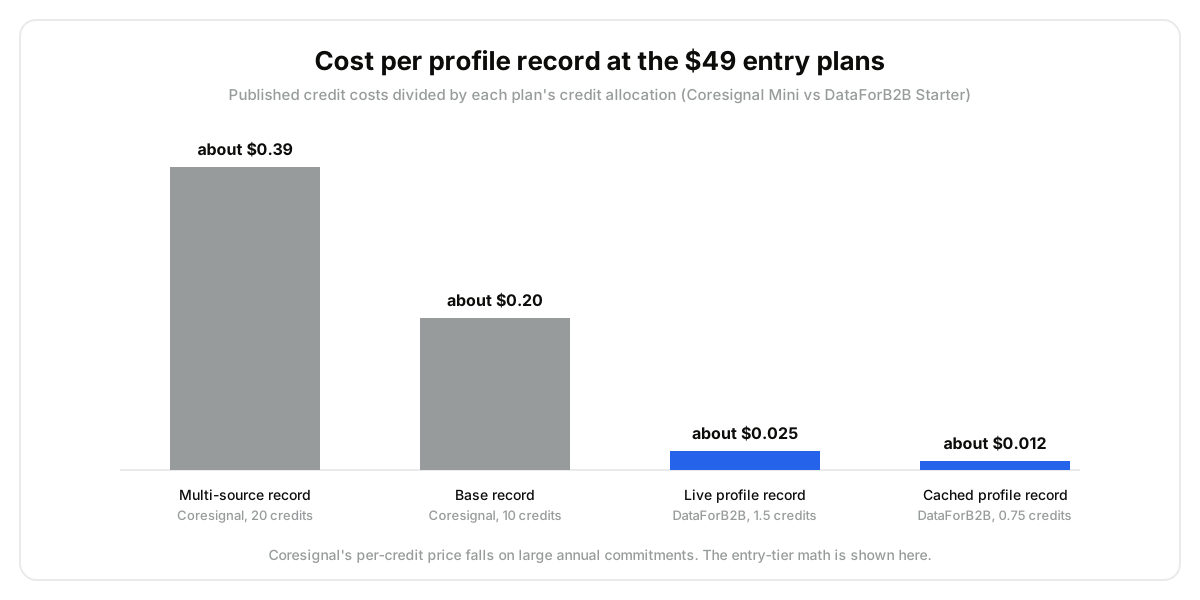
Per-operation pricing produces a different curve. A cached profile record costs 0.75 credits, a live fetch 1.5, a verified work email 1, a phone 10. On a $49 plan with 3,000 credits, that is about 4,000 cached records, or 2,000 live ones, roughly $0.012 to $0.025 per profile.
Why Do Builders Look for a Coresignal Alternative?#
Three reasons show up in practice: the per-record credit math at self-serve tiers, contact data gated behind the $499 plan, and a dataset model that asks your team to own a copy of the data and keep it fresh. Each one weighs differently depending on what you build.
The record meter. Ten to twenty credits per collected record is fine when a $1,500-plus plan makes credits cheap. At $49 or $199, each record is a real spend decision.
The plan gate. An agent that needs a verified work email cannot get one below Pro. That puts a $499 floor under a common workflow.
The copy problem. A dataset you ingested is as fresh as your last refresh. One RevOps team we read described the failure mode exactly: a decision-maker changed jobs days after the monthly enrichment run, and the stale record sat in the CRM for weeks.
Dataset Refresh or Request-Time Query?#
This is the real architectural choice behind the vendor choice. A dataset model ships you a copy: you ingest it, serve from it, and refresh on a schedule. A request-time model answers each query live: no copy, no sync layer, freshness equal to the moment of the call.
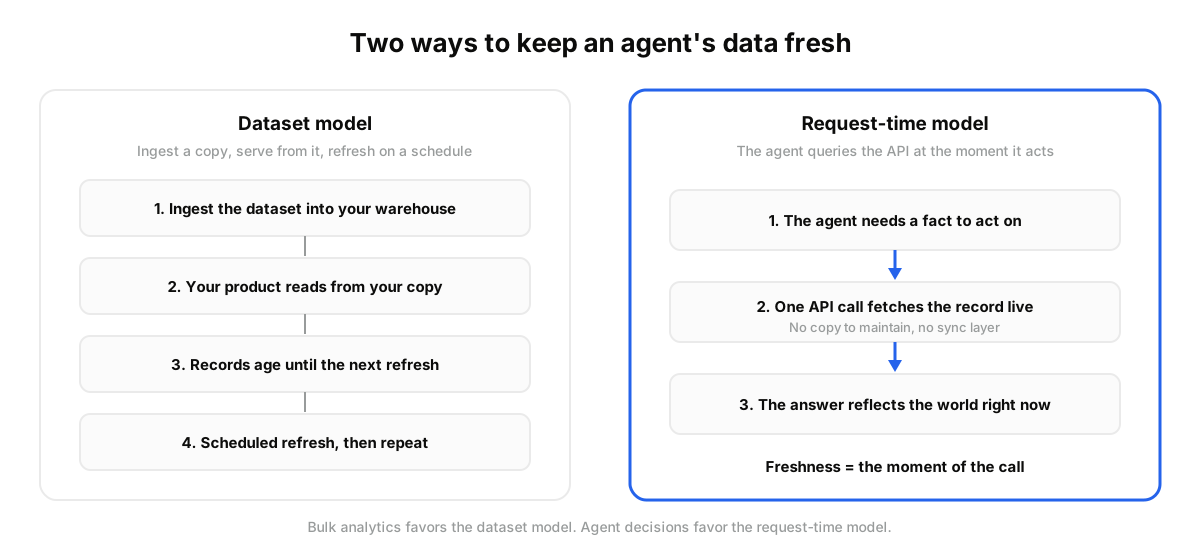
Neither is wrong. Bulk analytics, market research, and model training want the dataset: millions of records, local joins, no per-request latency.
Agent decisions want the query. When an AI SDR drafts an opener, the question is "where does this person work today", not "where did they work at the last refresh".
The teams that get burned are the ones running agent workloads on a dataset cadence. The fix some of them land on: keep slow-moving fields on the periodic refresh, and move fast-moving facts, like current employer, to change-based updates. A job-change webhook does that without any re-polling.
When Is DataForB2B the Better Fit?#
It fits when your product or agent queries at request time and pays per operation. Search runs on 60+ people filters and 40+ company filters, including funding stage and growth signals. Enrichment aggregates 20+ sources into one record, with the contact fields included on every plan, free tier included.
One call shows the pricing model:
curl -X POST 'https://api.dataforb2b.ai/enrich/profile' \
  -H 'api_key: YOUR_API_KEY' \
  -H 'Content-Type: application/json' \
  -d '{
    "profile_identifier": "YOUR_PROSPECT_PROFILE_URL",
    "enrich_profile": true,
    "enrich_work_email": true
  }'
That returns the full live profile plus a verified work email for 2.5 credits, about four cents on the entry plan. The equivalent path on a record-collection model is a collect at 10 to 20 credits plus a 20-credit contact enrichment, on a plan that starts at $499.
The signal surface is wider than profiles and companies. Posts search covers LinkedIn, X, and Reddit by keyword, and returns who engaged with each post, so a thread full of people asking for a tool becomes a lead list. Jobs search pulls postings from LinkedIn and Indeed on one normalized schema.
What builders run on it, by vertical:
- A sales tool searches RevOps leads at 51-200 person SaaS companies that raised a series_a, then enriches only the matches.
- A GTM agent watches Reddit and X threads where buyers ask for tools in its category, and treats the authors as inbound-grade leads.
- A recruiting agent filters engineers by skills and tenure, and pulls GitHub activity for the shortlist.
- A deal-sourcing agent watches funding webhooks and gets the round pushed the day it lands.
The trade-off is honest and structural. There are no flat-file datasets to buy here. If you need 50 million records in Snowflake by Friday, this is the wrong counter.
Plans run $49 (3,000 credits), $150 (10,000), and $450 (40,000), with a free tier to start and custom unlimited above. Full grid on the pricing page.
Where Coresignal Is the Better Choice#
Pick Coresignal when the job is bulk. Warehouse-scale ingestion, market mapping across millions of companies, training data, headcount analytics over time: the dataset shape and the multi-source aggregation are built for exactly that.
The high tiers reward it. At Premium and above, credits get cheap enough that collecting records at scale stops being a line-item decision. Jobs data is strong too, at 1 credit per posting record.
And if your compliance team wants a vendor with a formal data-ethics certification program, theirs is the most visible in the category.
Other Coresignal Alternatives Worth a Look#
Coresignal is a dataset vendor, so the fair comparison set is other dataset and enrichment vendors, not only request-time APIs. These are the five that show up in the same evaluations.
- People Data Labs: the reference for bulk person and company datasets with a mature enrichment API. Best when you want to own a large slice of the graph and refresh it yourself.
- Crustdata: real-time people and company data with strong hiring and headcount signals. Pricing is credit-based and the enterprise gate sits early. See our Crustdata comparison.
- Explorium: prepaid data packs with firmographic and intent enrichment, positioned for GTM teams rather than builders. Details in the Explorium comparison.
- Bright Data: raw datasets and scraping infrastructure. The most flexible option if you have engineers to run the pipeline, and the most work to keep fresh.
- Clay: not a data vendor but an enrichment workflow layer that calls many of the vendors above. Right for ops teams, wrong as a database. Our Clay comparison for developers explains why.
DataForB2B is the request-time option in this set: no dataset to host, every call returns fresh data, and the price is per operation. If your team wants to own a refreshed dataset, People Data Labs or Coresignal itself is the better fit. If your agent needs the answer at query time, run the side-by-side test below.
How Do You Test the Two Side by Side?#
The fastest test does not need code. Both products expose MCP servers, so you can run the same questions from Claude and compare the answers, the freshness, and the credits burned.
- Create a free account at app.dataforb2b.ai/signup.
- Connect the MCP server in Claude: Settings, then Connectors, then add mcp.dataforb2b.ai/mcp. The same server works in Cursor, VS Code, ChatGPT, and custom agents.
- Paste a prompt that matches your real workload: "Find 25 heads of talent at 200 to 1,000 person fintech companies in London, and enrich the 10 best matches with a verified work email."
- Turn the conversation into a scheduled routine so the check runs weekly without you.
Run your own ICP through both. A published match rate averaged over someone else's population tells you nothing; fifty of your own records tell you everything.
If your workload is closer to queries than to copies, start on the free tier and run the side-by-side test above. The credit math will settle it faster than any comparison page, ours included. Details on the pricing page.
Frequently asked questions
- How much does Coresignal cost?
- Self-serve API plans run from $49 a month (Mini, 2,500 credits) to $5,000 a month (Elite, 10 million credits), with a 7-day free trial at 2,000 credits. Collecting one profile or company record costs 10 to 20 credits. Datasets are priced by quote and start around $1,000.
- What is the best Coresignal alternative for AI agents?
- For agents that query at request time, DataForB2B is the closest fit: per-operation credits (0.75 for a cached profile record, 1 for a work email), 60+ people filters, posts search across LinkedIn, X, and Reddit, MCP alongside REST, and a free tier. For bulk dataset ingestion, Coresignal keeps the stronger shape.
- Does Coresignal have a free tier?
- Coresignal offers a 7-day free trial with 2,000 credits rather than an ongoing free tier. After the trial, the smallest plan is Mini at $49 a month. Contact Enrichment and Search Preview are not included on Mini or Starter; both unlock from the Pro plan at $499 a month.
- Should you buy Coresignal datasets or APIs?
- Datasets suit teams that load millions of records into a warehouse and run their own refresh pipeline; they are quoted by sales and start around $1,000. The APIs suit record-level access on credits. The practical question is whether you want to own a copy of the data or query the source when you need it.
- What is the difference between Coresignal and DataForB2B?
- Coresignal centers on large multi-source datasets and record collection billed at 10 to 20 credits per record. DataForB2B centers on request-time search and enrichment billed per operation, 0.75 to 10 credits, with funding filters, job-change webhooks, and contact data on every plan. Bulk copies on one side, live queries on the other.