Coresignal vs Crustdata 2026: Pricing, Freshness & Fit
Coresignal vs Crustdata in 2026: published credit costs, what each vendor gates, a worked example for 1,000 fresh profiles, and a live per-call option for agents.
Coresignal vs Crustdata is a question about meters, not features. Both aggregate public professional data from 15+ sources into one schema, and both sell it to teams building sales, recruiting and investment products. They charge for it in two different ways, and that difference decides your bill.
One sells datasets first and meters the records you collect. The other sells an API first, meters cached reads cheaply, then gates the live and contact endpoints behind higher plans.
This page puts the two side by side on published numbers. It then adds a third option for teams whose agent needs the answer at request time.
Key Takeaways#
- Coresignal meters collected records at 10 to 20 credits each, on self-serve plans from $49 to $5,000 a month. Contact enrichment unlocks at the $499 Pro plan.
- Crustdata meters search at 0.03 credits per result and cached enrichment at 1 to 7 credits. Live and contact endpoints sit on gated plans, and named plan prices are not published.
- One fresh profile with a work email costs 30 to 40 credits on Coresignal, up to 12 on Crustdata enterprise endpoints, and 2.5 on a per-operation API.
- Bulk ingestion favours Coresignal. Cheap cached discovery favours Crustdata. Request-time agent decisions favour a live, per-operation model.
Coresignal vs Crustdata at a Glance#
Coresignal is a dataset vendor with credit-based APIs on top. Crustdata is an API-first provider with a cached tier and gated live endpoints. The table below normalises both to published credits and dollars, with a per-operation API in the third column as the reference point for agent workloads.
| Criterion | Coresignal | Crustdata | DataForB2B |
|---|---|---|---|
| What you buy | Datasets plus credit APIsFlat files quoted from about $1,000 | API onlyCached tier, gated live tier | API onlyLive at every call |
| Coverage claimed | 895M+ profiles15+ sources | 1B+ profiles, 60M+ companies15+ sources | 800M+ profiles, 75M+ companies20+ sources on enrichment |
| Entry price | $49/mo, 2,500 credits7-day trial, 2,000 credits | $95/mo lowest tierPlan prices not published | $49/mo, 3,000 creditsFree tier |
| Search | FreeYou pay when you collect | 0.03 credits per resultZero-result searches free | 0.75 credit per cached result1.5 live |
| One profile record | 10 credits base20 multi-source | 1 to 7 credits cached7 live, plan gated | 1.5 credits liveEvery plan |
| Work email | 20 creditsPro plan, $499, and up | +1 credit cached1 to 5 contact enrich, enterprise | 1 creditEvery plan |
| Social posts | No | One networkLive-access plans | LinkedIn, X, RedditEvery plan |
| Job postings | Yes1 credit per posting record | Yes | YesLinkedIn and Indeed, one schema |
| Rate limits published | 5 requests per second on Mini | 15 per minute cached10 live, 30 search | Not the deciding factorAsk before a large batch |
| Best for | Warehouse-scale ingestion | Cheap cached discovery, technographics | Agents that decide at request time |
Scroll sideways for every column
Two numbers in that table carry most of the weight. Crustdata's 0.03 credits per search result is the cheapest discovery in the category. Coresignal's 20-credit contact enrichment, behind a $499 plan, is the most expensive path to a work email.
What Does Each One Cost for 1,000 Fresh Profiles?#
A month of 1,000 fresh profiles with a work email lands on the $499 Pro plan at Coresignal, on an enterprise quote at Crustdata, and inside a $49 plan on a per-operation model. The record is the same. The meter is not.
Run the math on Coresignal first. A base record is 10 credits and a contact enrichment is 20, so each profile is 30 credits. One thousand of them is 30,000 credits, which fits Pro at 35,000. Choose the multi-source record instead and it is 40,000 credits, which pushes you to Growth at $1,000.
On Crustdata the cheap path is cached: base profile 1 credit, business email 1 more. Two thousand credits for the batch. The catch is age. A cached record is as fresh as the last crawl, and the live path is 7 credits plus 1 to 5 for contact data, up to 12 per profile, on plans that start with a sales conversation.
Per operation, a live fetch is 1.5 credits and a verified work email is 1. That is 2,500 credits for the batch, inside the $49 plan with 3,000 credits, and the contact fields are not gated on any tier.
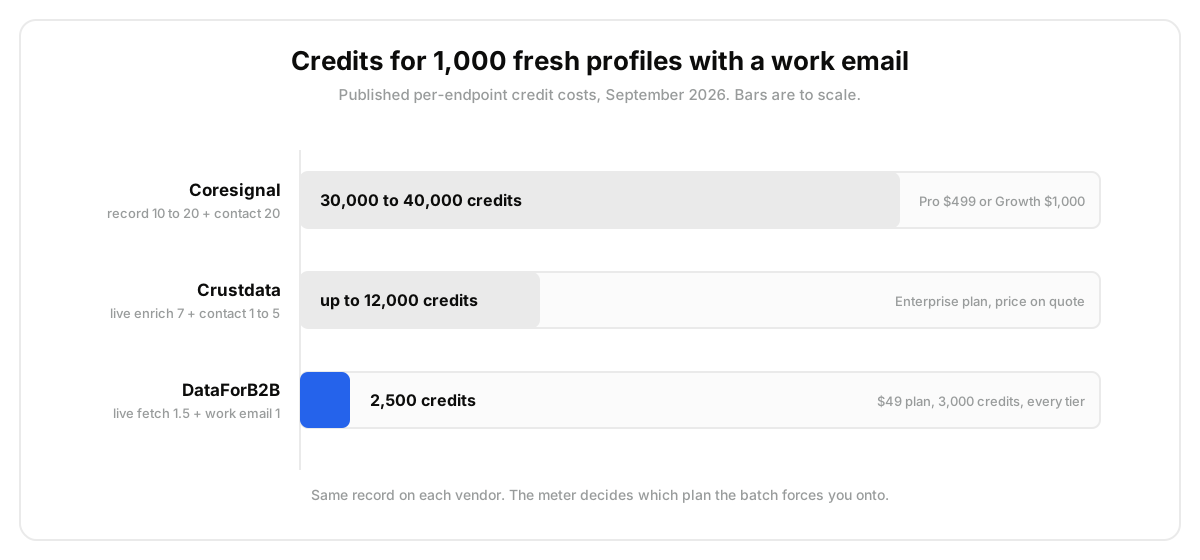
The mistake most teams make is comparing entry prices. $49 against $95 says nothing. Compare what one month of your real workflow consumes on each meter, and check which plan that volume forces you onto.
Which One Is Fresher?#
Freshness depends on which endpoint you can afford, not on which vendor you pick. Coresignal's API returns the latest record it holds, while its datasets age between scheduled refreshes. Crustdata's live endpoints query at request time, but they sit on gated plans, and its self-serve tier reads a cache.
A public vendor test makes this concrete. The agency 42agency checked one verified job change against twelve data sources two weeks after the move. The cached answers, Crustdata's among them, still returned the old employer. Sources that query live at the moment of the call got it right.
Builders say the same thing in their own words. One founder who compared six enrichment APIs on the same 349 resolved domains described the exercise as the only way to see real freshness, because every vendor claims it. Another chose Coresignal for the depth of its records, then noted that depth and recency are different fields.
What surprised us was how often the cheap tier is the stale tier. That is not a trick. Caching is what makes 0.03 credits per result possible. It just means the price you compare on is not the price of the answer your agent needs.
Who Should Pick Coresignal?#
Pick Coresignal when the job is bulk. Warehouse-scale ingestion, market mapping across millions of companies, training data, and headcount analytics over time all want a dataset you own and join locally. The multi-source aggregation and the flat-file delivery are built for exactly that.
The high tiers reward it. At Premium, $1,500 for a million credits, a credit costs about a fifth of what it costs on Mini. Collecting records at scale stops being a line-item decision. Jobs data is strong too, at one credit per posting record.
One RevOps team wrote publicly about running Coresignal's MCP server with Claude Code for enrichment and called it one of the cleaner integrations they had tried. Add the most visible data-ethics program in the category, and a compliance review goes faster.
Not for you if your agent needs a work email on a $49 budget. That field opens at $499.
Who Should Pick Crustdata?#
Pick Crustdata when cheap cached discovery is your core loop. Nothing in the category beats 0.03 credits per search result for building large filtered lists, and the free company identify endpoint is useful plumbing before you spend anything.
Stay for the depth it goes into: technographics on company records, developer-platform signals, employee reviews, and a monthly S3 flat file next to the API. The documentation is genuinely good, and one builder called its real-time search option something they had not seen at other providers.
The honest trade-off, in the words of another user: the data was decent but it got pricey fast once bulk needs appeared. That is the gate talking. Live people endpoints, contact enrichment and social posts all sit on plans most self-serve builders do not have, and credits expire six months after purchase.
Not for you if you need those gated capabilities daily on a self-serve budget. Then the gate is the price.
Is There a Third Option for Agent Builders?#
Yes. A per-operation API answers every query live, prices each call, and keeps contact fields open on every plan, free tier included. DataForB2B is built on that model: 800M+ profiles, 75M+ companies, 60+ people filters and 40+ company filters, over REST, MCP and webhooks. No dataset to host, no cache to refresh.
Take a three-person team building a deal-sourcing agent. It watches 1,200 founders who left a top-50 tech company in the last twelve months. Each week it refreshes current role and pulls a work email only for the 60 who started something new. That is 60 live fetches and 60 emails, 150 credits, on the $49 plan.
One call shows the shape:
curl -X POST 'https://api.dataforb2b.ai/enrich/profile' \
  -H 'api_key: YOUR_API_KEY' \
  -H 'Content-Type: application/json' \
  -d '{
    "profile_identifier": "https://www.linkedin.com/in/the-founder-you-track",
    "enrich_profile": true,
    "enrich_work_email": true
  }'
The signal surface is wider than profiles. Posts search covers LinkedIn, X and Reddit by keyword and returns who engaged, so a thread where buyers ask for a tool becomes a lead list. Jobs search reads LinkedIn and Indeed on one schema.
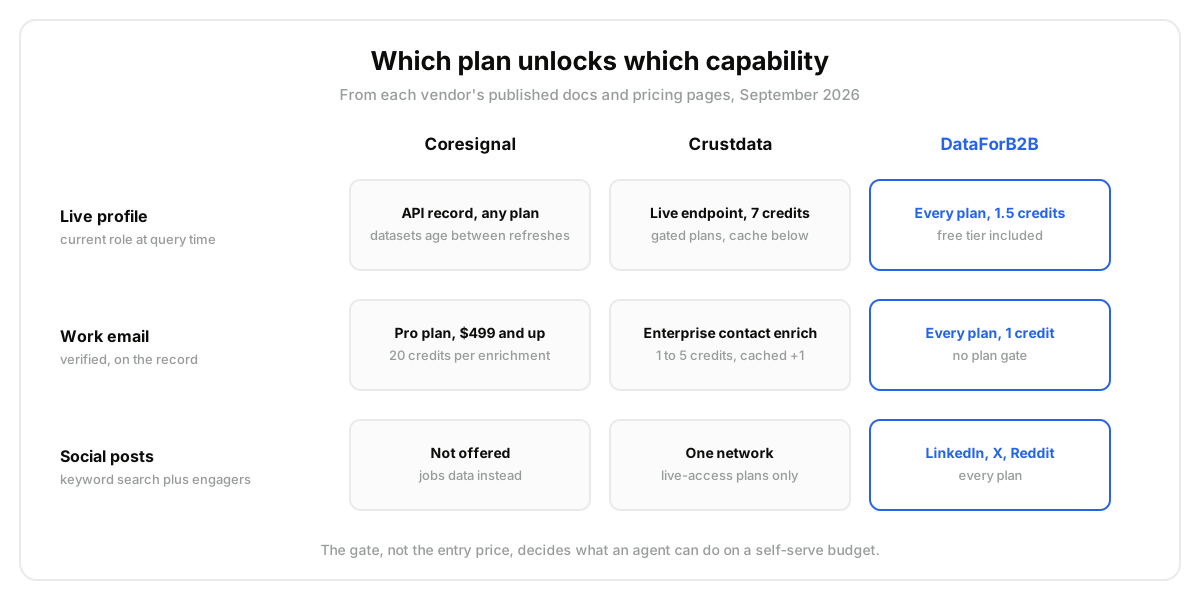
The trade-off is structural and worth saying plainly. There are no flat-file datasets here. If you need 50 million records in Snowflake by Friday, Coresignal is the right counter. Plans run $49, $150 and $450 a month, with a free tier to start. Grab an API key on the pricing page.
You are probably wondering about integration time. A search is one POST request. The MCP path skips even that, because the agent calls the tool natively.
How Do You Run a Side-by-Side Test?#
You run a side-by-side test by taking one list you already trust, sending the same 100 profiles through each provider on the same day, and scoring three things: how many current employers were right, how many work emails came back, and what the batch cost on the plan it forced you onto.
- Create a free account on app.dataforb2b.ai/signup and pull an API key. Do the same on the Coresignal trial and the Crustdata self-serve tier.
- Connect the MCP server in Claude under Settings, then Connectors, at https://mcp.dataforb2b.ai/mcp. The same server works with Cursor, VS Code, ChatGPT and any MCP-compatible agent.
- Paste a prompt that runs the test: "Take these 100 LinkedIn profiles of RevOps leads, refresh each one's current company and title, add a verified work email where one exists, and flag every profile whose employer changed since the CSV date."
- Turn the conversation into a scheduled routine, weekly, so the freshness score is measured over a month rather than one afternoon.
Keep the list identical across providers. The only variable should be the meter and the freshness, and the numbers will tell you which one you were really paying for. Our Coresignal comparison and Crustdata comparison go deeper on each vendor alone.
Both vendors are good at the job they were built for. The question is whether your workload looks like a warehouse, a list, or a conversation happening right now. See the live grid on the pricing page and run the 100-profile test this week.
Frequently asked questions
- Is Coresignal cheaper than Crustdata?
- It depends on the record. Crustdata's cached search, at 0.03 credits per result, is cheaper for discovery. Coresignal's collected records cost 10 to 20 credits each but its plan prices are published, from $49 to $5,000. For a fresh profile with a work email, Coresignal needs a $499 plan and Crustdata an enterprise quote.
- Does Crustdata publish its pricing?
- Partly. Crustdata publishes the credit cost of each endpoint in its docs, and its own cost guide says the lowest tier starts at $95 a month, with the dollar value per credit set by plan. Named plan prices are not on the pricing page. Live and contact endpoints require a sales conversation.
- Which is better for real-time data, Coresignal or Crustdata?
- Crustdata has dedicated live endpoints, but they sit on gated plans, and its self-serve tier reads a cache. Coresignal's API returns the latest record it holds, and its datasets refresh on a schedule. For request-time decisions on a self-serve budget, a per-operation API that queries live on every plan is the more direct fit.
- Do Coresignal and Crustdata offer flat-file datasets?
- Yes, both do. Coresignal's datasets are quoted by sales and start around $1,000, and bulk is its center of gravity. Crustdata offers a monthly S3 flat file next to its API. A per-operation API does not sell datasets, which is the trade-off for live answers at every call.
- What is the best alternative to both for AI agents?
- For an agent that decides at request time, a per-operation API with live fetches, contact fields on every plan, and MCP access is the closest fit. It prices the call, not the collected record, so 1,000 fresh profiles with a work email cost about 2,500 credits on a $49 plan instead of a $499 plan or an enterprise quote.