Best Apollo API Alternatives 2026: 9 Data APIs Compared
Apollo API alternatives for 2026: nine data APIs compared on whether the API is the product, what you pay for, rate limits, work email gates and MCP access.
Apollo is a very good application. That is the problem for anyone searching for an Apollo API alternative: the API is a door at the back of the building, and the building was designed for a person with a mouse.
API access sits on Custom plans. Rate limits run 50 to 200 requests a minute depending on tier, with a 200-an-hour cap that one r/gtmengineering user says "only really lifts on their custom enterprise plan." Enrichment burns up to 9 credits a record. And the meter is the seat, which an agent does not have.
This page compares nine alternatives for teams that want the data without the dashboard: what each one meters, what API access costs, how fresh the record is, and where Apollo still wins. Prices from vendor pages and docs, checked in September 2026.
Key Takeaways#
- Apollo prices per user, from $49 a month on annual billing, with credits on top and API access reserved for Custom plans. Enrichment consumes up to 9 credits per record.
- Reddit users report "verified" emails bouncing 20 to 30 percent and find rates in the fifties on EU lists. The database is the complaint, not the UI.
- Three alternatives price the operation instead of the seat, which is the meter an agent needs. Two are API-first with MCP on every plan.
- Stay on Apollo if your reps live in the sequencer and the dialer. Leave when the caller is software.
How Did We Evaluate These Alternatives?#
We scored each vendor on five things: whether the API is the product or an add-on, what you pay for (seat, credit or operation), the published rate limits, the plan that unlocks a work email, and whether MCP and webhooks ship next to REST. Where a vendor publishes its people count we quote it; we did not audit it.
We did not score sequencing, dialing or the Chrome extension. Those are the reasons to stay on Apollo, and they belong in the last section, not in the table.
The 9 Apollo API Alternatives at a Glance#
| Vendor | API is | You pay for | Entry price | Rate limits published | Work email | Access | Best for |
|---|---|---|---|---|---|---|---|
| Apollo.io (baseline) | Add-onCustom plans | Seats plus credits | Free$49 per user annual | 50 to 200 a minute200 an hour on most tiers | Up to 9 credits a record | REST, MCP | Reps in a sequencer and dialer |
| 1. DataForB2B | The product | Operations | Free tier$49 for 3,000 credits | Ask before a large batch | 1 creditevery plan | REST, MCP, webhooks | AI SDR agents and embedded products |
| 2. Crustdata | The product | Credits | $95/mo lowest tierplans not published | 15 a minute cached10 live, 30 search | Enterprise1 to 5 credits | REST, MCP | Cheap cached discovery |
| 3. People Data Labs | The product | Records | $98/moabout 350 records | Per plan | Pro planobfuscated on free | REST, flat files | Bulk datasets you own |
| 4. Coresignal | The product | Credits per collected record | $49/mo2,500 credits | 5 a second on Mini | Pro plan, $49920 credits | REST, MCP, flat files | Warehouse ingestion |
| 5. Clay | Add-onGrowth plan | Actions and data credits | FreeLaunch $167/mo annual | Per provider | Via providers | HTTP API, MCP | Ops teams chaining providers |
| 6. Prospeo, FullEnrich | The product | Verified contacts only | Free creditspaid tiers | Per plan | Pay on hit only | REST | Email and phone top-up |
| 7. Cognism | Add-on | Seats | Quoted | Per contract | Included | REST | EU and UK phone-verified data |
| 8. ZoomInfo | Add-on | Seats | Quoted"$15k a seat minimum" per Reddit | Per contract | Included | REST | Enterprise org charts and mobiles |
| 9. Hunter | The product | Requests | Freepaid tiers | Published per plan | Finder and verifier | REST | Verification layer |
Scroll sideways for every column
The first column is the one that matters. On four of the nine, the API is an add-on to a seat product. On five it is the product. An agent builder should read no further down a row where the API is an add-on, because every gate, limit and price on that row was designed with a human user in mind.
What Does Apollo Actually Cost for an API Workload?#
Apollo prices per user: Free, then Basic, Professional and Organization at $49, $79 and $119 a user a month on annual billing, with a credit pool per plan. API access "on our Custom plans for more advanced integrations" is Apollo's own phrasing. Enrichment endpoints consume credits when qualifying data is returned, up to 9 per record.
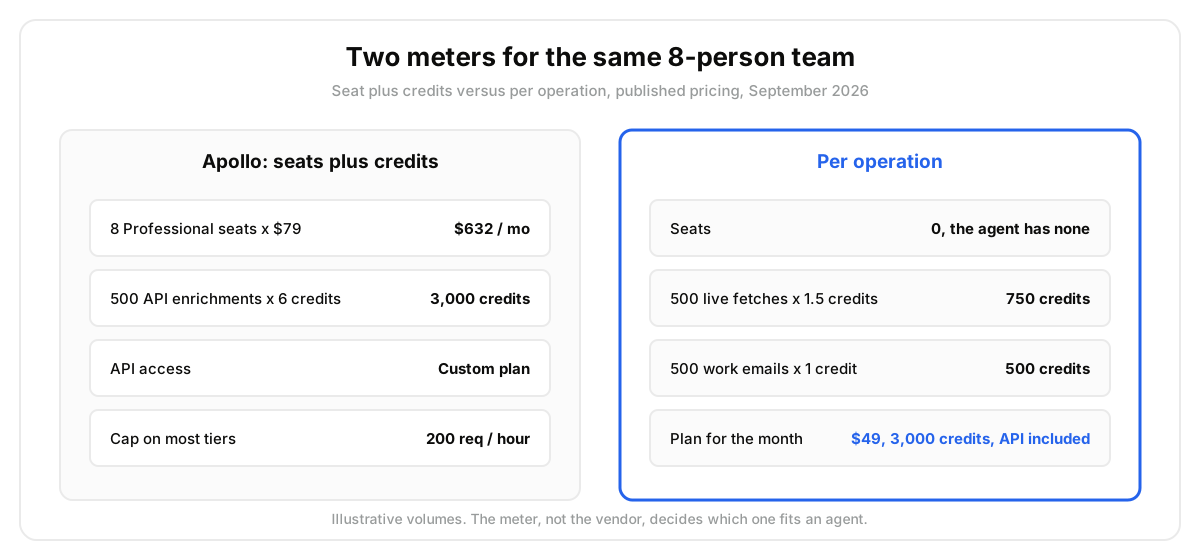
Run the math for an eight-rep team, the size of the r/gtmengineering thread that started this comparison. Eight Professional seats is $632 a month before credits. A single API enrichment run of 500 contacts at 6 credits is 3,000 credits, which one cost guide puts at $200 to $400 on top. Then the 200-an-hour cap turns a 10,000-record job into a two-day job.
None of that is unfair for a sales team. It is the wrong shape for an agent. An agent has no seat, runs at 3am, and wants 10,000 records in an hour.
Why Do Builders Look for an Apollo API Alternative?#
Three reasons come up on every thread. The data: "verified emails bounce 20 to 30 percent", "great for emails, crap for phone numbers", "find rate somewhere in the 50s" on EU lists. The meter: seats and credits for a caller that has neither. And the gate: API on Custom plans, 200 requests an hour below that.
An SDR lead on r/gtmengineering described the loop exactly. Eight reps on Apollo, find rate in the fifties, mobile coverage dropping off on anything EU-based, "burning through credits on bad data and eating into send limits with bounces." The question was whether a waterfall would help or just add another bill.
The mistake most teams make at that point is to bolt a second tool onto Apollo. The bill doubles and the seat meter stays. The fix that lasts is to move the data layer to something priced for the caller you actually have.
Paying for the Operation, Not the Seat#
A per-operation meter charges for what the agent does: a search result, a live profile fetch, a verified email. There is no user count in the invoice, so a product with 40 customers and an agency with 12 clients pay for volume, not headcount. That is the structural difference between an API built for agents and an API attached to a seat product.
A per-operation API prices this way. Here a cached search result is 0.75 credits, a live fetch 1.5, a verified work email 1, on every plan from the free tier up. Plans run $49 for 3,000 credits, $150 for 10,000 and $450 for 40,000. Coverage is 800M+ profiles and 75M+ companies, against the 200M-range figures Apollo's own materials and third-party reviews put on its contact database. More records, and each one fetched live rather than stored.
One call replaces the Apollo people search plus enrichment pair:
curl -X POST 'https://api.dataforb2b.ai/search/people' \
  -H 'api_key: YOUR_API_KEY' \
  -H 'Content-Type: application/json' \
  -d '{
    "filters": {
      "op": "and",
      "conditions": [
        {"column": "current_title", "op": "like", "value": "Head of Sales"},
        {"column": "profile_country", "op": "=", "value": "DE"},
        {"column": "current_company_size", "op": "in", "value": ["51-200", "201-500"]},
        {"column": "current_company_funding_stage", "op": "=", "value": "series_a"}
      ]
    },
    "count": 25,
    "enrich_live": true
  }'
Twenty-five heads of sales at Series A companies in Germany, fetched live, for about 38 credits. Add a work email on the ones the agent decides to contact, 1 credit each. Nobody bought a seat.
The trade-off is structural and worth saying plainly. There is no sequencer here, no dialer, no Chrome extension. The agent is the interface. If your reps want to click, this is the wrong counter.
What Does an AI SDR Actually Need From the Data Layer?#
An AI SDR needs four things from its data API: a search deep enough to express the ICP, a fetch fresh enough that the opener lands on the right desk, a contact field it can afford on every record it decides to use, and a trigger so it acts on a change rather than a schedule. Apollo supplies the first two for a human and gates the third and fourth behind plans and limits.
Take a two-person team building an outbound tool for recruiting agencies. Their agent searches heads of talent at 200 to 1,000-person companies that grew headcount 10 percent in six months, gets 80 matches, and pulls a work email only for the 30 whose company also posted a recruiter role this month. That is 80 search results, 30 emails and one jobs query, well under 200 credits, and the jobs signal is the part Apollo does not expose as a filter.
The mechanism matters more than the number. Because the agent pays per operation, it can afford to search wide and enrich narrow. On a seat-plus-credits model, every search competes with every enrichment for the same monthly pool.
Builders can wire this against the live API today. Start on the free tier on the pricing page.
Where Apollo Still Wins#
Stay on Apollo if your reps live in it. The sequencer, the dialer, the Chrome extension on LinkedIn and the CRM sync are a finished product that a small sales team can run on day one, and Reddit calls it "the best value" for exactly that reason. Email coverage in North America is broad and cheap.
Stay too if your volume is human-shaped: a few hundred enrichments a month from inside the app, where the credit pool is generous and the API cap never bites.
The calculation changes when the caller is software. Then the seat is a tax, the hourly cap is a wall, and the 20 to 30 percent bounce rate is a cost you pay in domain reputation, not just credits.
The Other Alternatives, Briefly#
Crustdata is API-first with the cheapest discovery in the category at 0.03 credits a search result and search filters builders praise. Live people data and contact enrichment sit on gated plans. Our Crustdata comparison has the full credit table.
People Data Labs sells the dataset: 3B+ records at about $0.28 each on self-serve, refreshed on a batch cadence. Right for bulk. See the People Data Labs alternatives page.
Coresignal is the other dataset vendor, with credit APIs from $49 and contact enrichment from the $499 plan. Details in the Coresignal comparison.
Clay orchestrates many providers, Apollo included, in a table. Right for ops teams, wrong as a database. Our Clay comparison for developers explains why.
Prospeo and FullEnrich charge only when a contact verifies, which fixes the bounce complaint directly. They are a top-up layer, not a search.
Cognism is the EU pick for phone-verified data on a seat model. ZoomInfo is the enterprise incumbent, strong on mobiles and org charts, priced far above this list. Hunter is a solid verifier with a small database, better as a layer than a source.
How Do You Run a Side-by-Side Test?#
You run it by exporting one Apollo list you already sent, re-fetching the same 200 people on a per-operation API the same day, and scoring: how many current employers matched, how many work emails came back, how many bounced when you sent, and what each side cost on the plan the volume forced you onto.
- Create a free account on app.dataforb2b.ai/signup and pull an API key.
- Connect the MCP server in Claude under Settings, then Connectors, at https://mcp.dataforb2b.ai/mcp. The same server works with Cursor, VS Code, ChatGPT and any MCP-compatible agent.
- Paste the prompt: "Here are 200 contacts from last month's Apollo export. Refresh each one's current company and title, find a verified work email where one exists, mark the ones whose employer changed, and estimate the bounce risk of the original list."
- Turn it into a scheduled routine, weekly, so the comparison covers a month of changes rather than one export.
Keep the list identical on both sides. The only variables should be freshness and the meter, and the invoice will tell you which one you were really paying for.
Apollo is the right tool for a rep and the wrong shape for an agent. If your caller is software, price the operation, not the seat, and start on the free tier on the pricing page.
Frequently asked questions
- Is the Apollo API key free?
- You can generate a key on a free account, but Apollo states that API access for advanced integrations sits on its Custom plans, and users report endpoints depending on account and trial status. Free-tier rate limits are 50 requests a minute and 200 an hour. Enrichment endpoints consume credits from your plan's pool regardless of tier.
- Who is Apollo's biggest competitor?
- ZoomInfo for enterprise sales teams, and Cognism in Europe. For API workloads the competitors are different: Crustdata, People Data Labs and Coresignal on the data-vendor side, and per-operation APIs like DataForB2B for agents. The right competitor depends on whether the user is a rep with a dashboard or a program with a key.
- What can I use instead of Apollo for an AI agent?
- Use a data API where the API is the product, not an add-on: REST plus MCP on every plan, priced per operation rather than per seat, with a work email available without a plan gate. DataForB2B fits that shape, with 800M+ profiles fetched live. Crustdata's live tier fits too if your budget reaches its gated plans.
- Is there anything better than Apollo for data quality?
- For email deliverability, contact waterfalls like Prospeo and FullEnrich charge only on verified hits, which directly addresses the 20 to 30 percent bounce reports. For freshness, a request-time API returns the current employer at the call rather than a stored record. For EU phones, Cognism. Better depends on which failure you are seeing.
- Does Apollo have an MCP server?
- Yes. Apollo's developer docs list an MCP alongside its REST API and CLI, so an agent can call Apollo tools natively. The meter does not change: the account behind the MCP still needs a plan, credits still burn per enrichment, and the rate limits of that plan still apply to every tool call.