Best PitchBook API Alternatives 2026: 9 Options for VC Data
PitchBook API alternatives for 2026: nine databases and signal APIs compared on deal history, funding signals, founder moves and pricing, and what none replace.
PitchBook costs more than most seed funds' first analyst. Third-party estimates put a licence between $12,000 and $70,000 a year depending on seats and modules, sold annually, with the API as an add-on. On r/venturecapital the threads are titled "Pitchbook is too expensive, any suggestions?" and "Building an open-source alternative to Pitchbook."
So the search for a PitchBook API alternative is really two searches. One is for the deal database itself, and PitchBook is genuinely hard to replace there. The other is for the sourcing signal, who raised, who left, who is about to start something, and that is where an API priced per call changes the economics of a small fund.
This page separates the two. Nine alternatives compared on published pricing, a section on what PitchBook does that nobody here replaces, and a workflow for the sourcing half. Numbers from vendor pages and labelled estimates, checked in September 2026.
Key Takeaways#
- PitchBook does not publish prices. Estimates run $12,000 to $70,000 a year, annual only, with the API sold on top. PitchBook's own site says pricing varies by seats and firm type.
- For deal history, valuations, LP data and exit prediction, PitchBook and its direct rivals (CB Insights, Crunchbase, S&P) are the category. No per-call API here replaces that.
- For sourcing signals, funding stage filters, funding webhooks and founder moves, a per-operation API runs a seed fund's deal flow for under $150 a month.
- Three alternatives here are free or have free tiers. The PAA question "is there a free alternative" has a real answer: for signals yes, for the database no.
How Did We Evaluate These Alternatives?#
We split the job first. For the database side we noted deal history, valuations, LP and fund data, and whether an API exists. For the sourcing side we scored funding-stage and investor filters, real-time funding alerts, founder and executive move detection, and pricing model. We quote coverage claims; we did not audit them.
The 9 PitchBook Alternatives at a Glance#
| Vendor | Job | Deal history and valuations | Funding signals | Founder moves | Pricing | API | Best for |
|---|---|---|---|---|---|---|---|
| PitchBook (baseline) | Database | Yesthe reference | Yesin-platform | Partialpeople module | Estimated $12k to $70k a yearannual, seats | Add-on | Funds that need the full record |
| 1. DataForB2B | Sourcing signals | No | Yesfilters plus webhook | Yespast_company, employment status | Free tier$49 for 3,000 credits | REST, MCP, webhooks | Deal-sourcing agents at seed and pre-seed |
| 2. Crunchbase | Database | Yeslighter than PitchBook | Yes | Partial | Pro from about $49 a monthAPI on paid tiers | Yesfree tier removed in 2026 | Founder-facing research on a budget |
| 3. Harmonic | Sourcing platform | Partial | Yes | Yesstealth founders | Not publishedestimates from $25k | Yesgated | Funds that want a sourcing console |
| 4. CB Insights | Database and research | Yes | Yes | No | Quotedenterprise | Yes | Market maps and research reports |
| 5. Dealroom | Database | YesEurope strong | Yes | Partial | Quoted | Yes | European ecosystems |
| 6. Tracxn | Database | Yesemerging markets | Yes | No | Quoted | Yes | Asia and emerging markets coverage |
| 7. Specter | Sourcing signals | No | Yesgrowth signals | Yes | Quoted | Yes | Growth-signal scoring |
| 8. OpenVC | Investor directory | No | No | No | Freepaid tiers | No | Founders finding investors |
| 9. SEC EDGAR and Form D | Primary source | Filings only | YesForm D, with lag | No | Free | Yespublic | US private placements at zero cost |
Scroll sideways for every column
The second column splits the table in half. Five vendors are databases and compete with PitchBook on its own ground. Four are signal sources and do a different job. A fund that buys a signal source expecting a database, or the reverse, will be disappointed on Monday.
What Does PitchBook Actually Cost?#
PitchBook does not publish a price list. Its pricing page says options vary by number of seats and firm type, licences are annual, and the API and data feed are priced separately. Published estimates from procurement trackers and user threads range from about $12,000 a year for a small team to $70,000 and above for enterprise, with reports of $7,000 a seat and multi-seat minimums.
Treat those figures as what they are: estimates and anecdotes, labelled as such. What is not in doubt is the shape. Annual, per seat, negotiated, with the API on top. For a two-partner seed fund, that is the second-largest line after salaries.
A founder on r/startups summarised the reaction: "Pitchbook seems great, but it is so expensive." The thread that ranks first for this query is someone building an open-source alternative rather than paying.
What Does PitchBook Do That Nothing Here Replaces?#
PitchBook holds the deal record: round-by-round financing details with valuations, cap table signals, LP and fund performance data, comparables, and an exit predictor built on all of it. That is a decade of curated private-market data, and no per-call people-and-companies API replaces it. Saying otherwise would be dishonest and this page will not.
If your job is diligence on a Series B, LP reporting, or valuing a portfolio against comps, you are shopping among databases: PitchBook, CB Insights, Crunchbase, Dealroom, Tracxn, S&P. The choice there is coverage by geography and stage, and price.
The sourcing half is a different job, and it is the one where most of the PitchBook bill is spent by small funds who only wanted to know who raised this week.
How Do You Source Deals Without a Licence?#
You source deals by filtering companies on funding stage, last round date and investor, then enriching the founders of the ones that match, and paying per call for exactly those steps. That replaces the screening use of PitchBook, not the database, and it runs on a monthly budget a seed fund can carry.
Per-operation company search here exposes funding stage, last funding amount and date, investor, employee growth over 1, 6 and 12 months, founding year and headquarters as native filters over 75M+ companies. One query:
curl -X POST 'https://api.dataforb2b.ai/search/companies' \
  -H 'api_key: YOUR_API_KEY' \
  -H 'Content-Type: application/json' \
  -d '{
    "filters": {
      "op": "and",
      "conditions": [
        {"column": "funding_stage_normalized", "op": "in", "value": ["pre_seed_round", "seed_round"]},
        {"column": "last_funding_date", "op": ">=", "value": "2026-06-01"},
        {"column": "employee_growth_6m", "op": ">", "value": 20},
        {"column": "country_iso_code", "op": "in", "value": ["DE", "FR", "GB"]}
      ]
    },
    "count": 50
  }'
Fifty European seed-stage companies that raised since June and grew headcount more than 20 percent in six months, for about 38 credits. The agent then enriches the founders of the ten that fit the thesis, a work email at 1 credit each, and the partner has a Monday list that cost under a dollar.
How Do You Catch a Round the Day It Lands?#
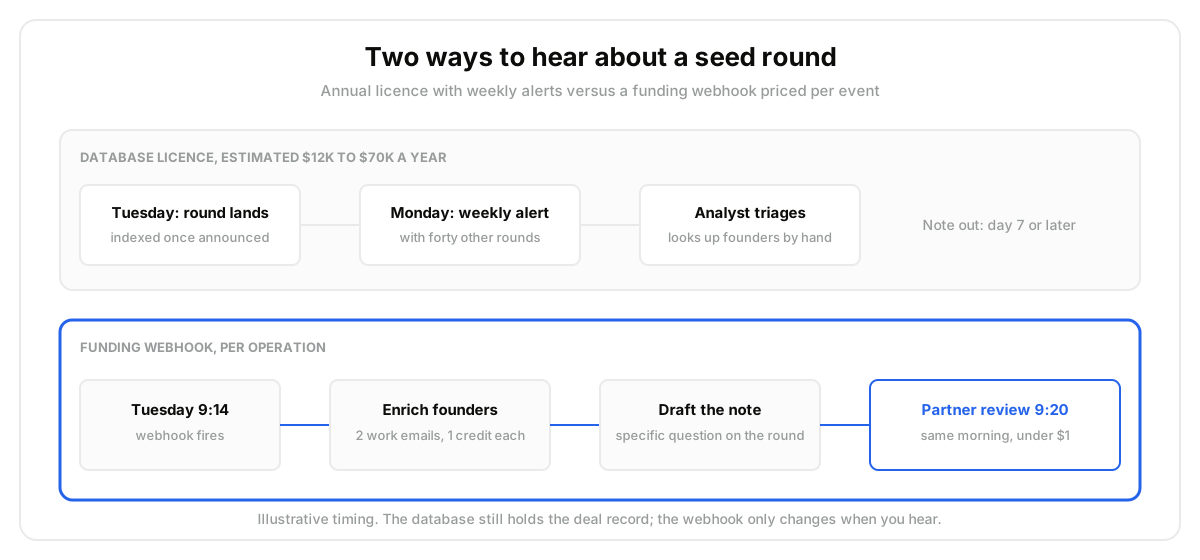
You catch it with a monitor: a webhook that fires when a company in your watch list, or matching your filter, records a funding event. That replaces the weekly PitchBook alert email with a push the day it happens, and it means the agent acts before the round is old news on LinkedIn.
A monitor is a signal, a watch list and a URL. Signal set to funding, watch set to the 400 companies your thesis covers, URL set to your agent's webhook. When a round lands, the event arrives with the company, and the agent runs the founder enrichment and drafts the note.
Take a two-partner seed fund in Berlin. Their agent watches 400 climate-hardware companies. On a Tuesday a pre-seed round lands at one of them. The webhook fires at 9:14am, the agent pulls the founders, verifies two work emails, and the partner has a congratulations note with a specific question about the round in draft by 9:20am. On a weekly alert the same note would go out the following Monday, with forty others.
How Do You Find Founders Before the Round Exists?#
You find them in the people graph, not the deal graph: an executive who left a top company in the last six months and has no current employer listed is often a founder in stealth. PitchBook indexes the deal once it is announced. A people search catches the move months earlier.
The query is a people search on past_company in a list of 50 target companies, years_in_current_position under one, and is_currently_employed set to false, or a new current company with fewer than ten employees. That is the stealth-founder pattern, and it is the information gain in this comparison: the database vendors do not offer it because it is not a deal yet.
What surprised us when we ran this for a fund was how many hits were already known to the partners through their network, and how many were not. The second group is the reason to run it.
Builders can wire this against the live API today. Start on the free tier on the pricing page.
The Other Alternatives, Briefly#
Crunchbase is the budget database: lighter than PitchBook on valuations and LP data, broad on companies and rounds, with Pro plans from about $49 a month. The free API tier was removed in 2026, so API access sits on paid annual plans. Our Crunchbase API review covers the details.
Harmonic is the closest thing to a sourcing platform for funds, strong on stealth founders and growth signals, with a console and a gated API. Pricing is not published; estimates start around $25,000. See the Harmonic comparison.
CB Insights pairs a database with research reports and market maps, priced for enterprise. Dealroom is the European database of record. Tracxn covers Asia and emerging markets. Specter scores companies on growth signals for sourcing. OpenVC is a free investor directory for founders. SEC EDGAR is the free primary source for US private placements via Form D, with a filing lag.
How Do You Run This Workflow in Claude?#
You run it by connecting one data source to Claude, describing your thesis as a filter, and letting a scheduled routine deliver the list and the funding events. No licence negotiation, about ten minutes, and the same connector works in Cursor and custom agents.
- Create a free account on app.dataforb2b.ai/signup and pull an API key.
- Connect the MCP server in Claude under Settings, then Connectors, at https://mcp.dataforb2b.ai/mcp. It works the same in Cursor, VS Code, ChatGPT and any MCP-compatible agent.
- Paste the prompt: "Find 50 pre-seed or seed companies in Germany, France and the UK that raised since June 2026 and grew headcount more than 20 percent in six months. For the ten that match a climate-hardware thesis, pull the founders and a verified work email, and set a funding monitor on all 50."
- Turn it into a scheduled routine, weekly for the list and event-driven for the monitor, so sourcing runs without a seat.
Keep PitchBook if you need the deal record. Run the signals on a meter you can afford. Most seed funds discover that the second half was most of what they paid for.
PitchBook is the deal record and it earns its price for that. Sourcing is a different job with a different meter. Grab a key on the pricing page and run the 50-company query this week.
Frequently asked questions
- Is there a free alternative to PitchBook?
- For the deal database, no complete one. SEC EDGAR Form D filings are free for US private placements with a lag, and OpenVC is a free investor directory. For sourcing signals, DataForB2B's free tier includes company search with funding filters and live founder enrichment, and Crunchbase's free web tier still works for lookups, though its free API was removed in 2026.
- Is the PitchBook API free?
- No. PitchBook's API and data feed are priced separately from the platform licence, which is itself annual and unpublished. Estimates for the platform range from $12,000 to $70,000 a year depending on seats and firm type. There is no self-serve or free API tier; access follows a sales conversation.
- Can ChatGPT access PitchBook?
- Not directly. PitchBook data sits behind a licence and does not ship a public MCP or connector for consumer assistants. An agent can access funding and founder data through APIs that publish an MCP server, such as DataForB2B at mcp.dataforb2b.ai, which works in Claude, Cursor and, through Custom GPT Actions, ChatGPT.
- What is the best PitchBook alternative for a small VC fund?
- Split the job. For diligence and comps, Crunchbase Pro is the budget database and Dealroom the European one. For sourcing, a per-operation API with funding-stage filters, a funding webhook and founder enrichment replaces the screening use of PitchBook for under $150 a month. Most small funds need the second more than the first.
- How do VCs find stealth founders before a round?
- By searching the people graph rather than the deal graph: executives who left a target company in the last six months with no current employer, or a new company under ten people. PitchBook indexes the round once it exists. A people search with past-company and employment-status filters catches the move months earlier, which is the sourcing edge.