How to Build an AI SDR That Runs on Signals (2026)
How to build an AI SDR that only reaches out on real signals: competitor-post engagement, hiring, and funding, with verified emails and honest volume.
Sales forums have settled on a harsh verdict about AI SDRs: most of them are mass email tools with a sequencer and a language model bolted on. The volume goes up, the replies do not, and the category keeps burning its own reputation.
The teams getting real meetings run the opposite build. Their agent barely writes. It watches.
This guide covers how to build an AI SDR that is signal-driven from the ground up: it acts only when something observable happens, a competitor's post getting engagement, a hiring spike, a funding round, and every touch carries a reason to exist.
Key Takeaways#
- The hard part of outbound is not writing, it is knowing who deserves a message and why now.
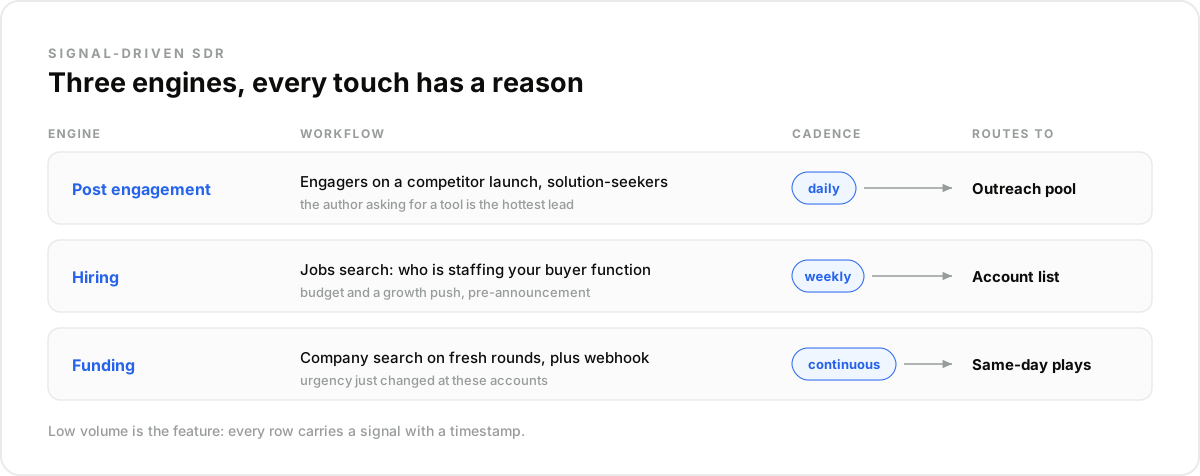
- Three signal engines cover most of it: competitor-post engagement, hiring activity, and funding events.
- Low volume is the feature. Every touch is tied to a signal with a timestamp.
- Enrich at send time for a verified work email, so the list never rots before it is used.
What Is a Signal-Driven AI SDR?#
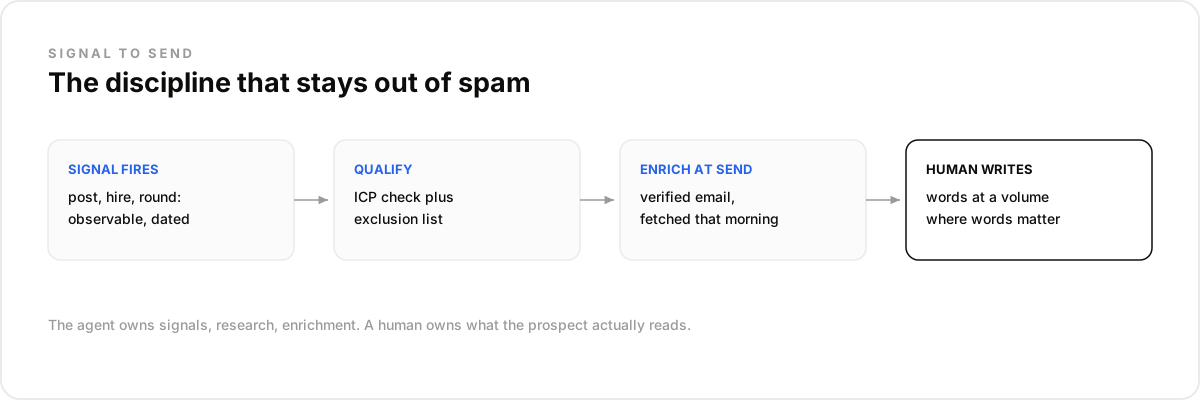
A signal-driven AI SDR is an agent that starts from an observable event rather than a static list. Someone engaged with a competitor's post, a target account opened three sales roles, a company in your segment raised: the agent notices, qualifies, enriches, and only then reaches out.
The inversion matters. A list-driven agent asks "how do I personalize this batch?" A signal-driven agent never has the problem, because the signal is the personalization: the reason to write arrived with the lead.
What an AI SDR Is NOT#
Three builds wear the name and produce the spam the category is blamed for. An AI SDR is not a sequencer with a model bolted on, not a scraper feeding a mail merge, and not a replacement for judgment about who matters. Each confusion produces a recognizable failure.
Not a smarter sequencer. Instantly or Smartlead already send well. Wrapping them in generated copy changes the wording, not the logic: the same thousand strangers get the same pitch.
Not a scraper plus mail merge. A pile of scraped contacts with generated first lines is volume outbound with extra steps, and inbox providers have learned to recognize the sentence skeleton.
Not autonomous judgment. The agent decides when a signal fires. A human still owns what your company sounds like when it shows up.
Which Signals Are Worth Acting On?#
Three signals carry most of the value: engagement on a competitor's content, hiring activity in your buyer's function, and a fresh funding round. Each one is observable, timestamped, and tied to a reason the prospect would recognize. That recognition is what separates outreach from interruption.
Rank them by heat. A person asking "anyone know a tool for X?" in a post is the hottest lead outbound will ever see. Engagers on a competitor's announcement are next: they cared enough to react. Hiring and funding are account-level heat, telling you where budget and urgency just appeared.
What that looks like across builds:
- An agent for a sales-tools startup watches the engagers on a rival's launch post and enriches the RevOps leads among them the same day.
- An agent selling devtools flags any 50 to 200-person company posting three or more backend roles in a month.
- An agent for a data product gets a webhook the morning a portfolio-fit company closes its seed round.
Best for: products whose buyers leave observable traces: they post, hire, raise, engage. Not for: markets with no public triggers, where demand has to be created rather than caught; a content motion beats any SDR agent there.
How Do You Turn a Competitor's Post Into a Lead List?#
One search call does it. Query posts by your competitor's name or category keyword, and attach the engagers: every reactor and commenter comes back with a name, a headline, and a profile URL. Those people just told the market they care about your problem space.
import requests

response = requests.post(
    "https://api.dataforb2b.ai/search/posts",
    headers={"api_key": "YOUR_api_key", "Content-Type": "application/json"},
    json={
        "keyword": "waterfall enrichment",
        "platform": "linkedin",
        "date_posted": "past_week",
        "include": ["reactions", "comments"]
    }
)

posts = response.json()["results"]
The same endpoint finds the hotter case: people asking for a solution outright. Search "looking for a tool" phrasings in your category and the author of the post, not the engagers, is the lead. They are in a buying window right now, and almost nobody reaches them before the thread goes cold.
Run it daily and the agent maintains a rolling pool of people with a documented reason to hear from you. That pool is what the rest of the build feeds on.
How Do Hiring and Funding Signals Fit In?#
Hiring and funding are the account-level engines. A jobs search surfaces companies opening SDR or RevOps roles, which means budget and a growth push. A company search filtered on recent funding rounds surfaces accounts whose urgency just changed. Both convert a market into a short daily list.
The chain is the same each time: the signal names the account, a people search finds the decision-maker in the relevant function, and enrichment makes them reachable. Three calls, and the agent has a contact plus the reason to write, attached.
Funding also works as a push. A monitor on funding events turns the morning query into a webhook that fires when a watched segment raises, so the agent reacts the day it happens instead of the week after. Our guide to tracking company funding signals goes deeper on that loop.
How Does Enrichment Keep You Out of Spam?#
Bounces burn sender reputation faster than bad copy, and stale contact data is where bounces come from. One team reviewing a popular AI SDR reported half its emails bouncing despite claimed verification. The fix is structural: enrich each contact live, at send time, never from a stored list.
The discipline is narrow and cheap. The signal pool might hold three hundred people; the agent contacts a dozen a day. Enriching those twelve at the moment of outreach, for a verified work email, keeps the spend tiny and the bounce rate near zero.
This is the trade-off worth naming: you give up the comfort of a big warmed-up list for a small pool that is verified the morning it is used. The inbox math strongly favors the second.
The signal engines above run on the live API. Wire one against your own market on the free tier via the pricing page.
The Mistake Most Teams Make#
The mistake most teams make is measuring the agent by activity. One GTM lead finally read the three hundred emails their AI SDR had sent in a month and found invented rapport, guessed personal details, and a sender reputation already past the cliff, all under a green dashboard.
The detail that stung: the meetings that did book traced back to the one segment where a human had written the sequence and the AI only handled research and scheduling. The robot had been taking credit for the intern's homework.
In our experience that split is the stable end state. The agent owns signals, research, and enrichment, the parts that reward speed and coverage. A human owns the words, at a volume where words can matter. What surprised us is how much better the replies get when the volume drops.
How Do You Run the Signal Engines in Claude or Any LLM Agent?#
All three engines run as a conversation before they run as a product. Connect the data tools to Claude over MCP and the competitor-post sweep, the hiring query, and the enrichment pass become briefs you type, then schedule.
- Create a free account at app.dataforb2b.ai/signup and grab your API key.
- In Claude, open Settings, then Connectors, and add https://mcp.dataforb2b.ai/mcp. The same server plugs into Cursor, VS Code, ChatGPT, or any MCP-enabled agent.
- Paste the brief: "Search posts from the past week where someone asks for a tool in our category, and enrich the authors for work emails."
- Turn the working chat into a scheduled routine so it runs daily without you.
An SDR agent is only as good as the signals it can see. DataForB2B exposes posts, jobs, funding, and enrichment behind one key, with an AI SDR data layer built for exactly this loop. Start on the pricing page.
Frequently asked questions
- Do AI SDRs actually work?
- Signal-driven ones do; volume clones mostly do not. Teams report the pattern consistently: mass-generated sequences decay into spam within months, while low-volume agents acting on real triggers, intent posts, hiring, funding, book meetings because the outreach has a reason the prospect recognizes.
- What does an AI SDR do that a sequencer does not?
- A sequencer executes a schedule against a list you already built. An AI SDR builds the list continuously from live signals, qualifies each entry, enriches the contact, and decides timing. The sequencer is the last step of the pipeline, not the pipeline.
- How do you keep an AI SDR out of spam?
- Three habits: verify every address at send time instead of trusting a stored list, keep volume tied to signals rather than quotas, and vary what gets written by grounding each message in the specific trigger. Reputation decays on bounces and template skeletons; remove both.
- Should the AI write the emails?
- At low volume, a human writing beats a model writing, and practitioners keep rediscovering it. The stable division: the agent finds the signal, researches the account, and drafts context; a person writes or approves what a prospect actually reads. Volume drops, replies rise.
- What data does an AI SDR need?
- Four feeds: social posts with engagers attached for intent, job postings for hiring signals, company records with funding fields for account triggers, and live enrichment for verified contact data. One data layer covering all four keeps the build to a single integration.