How to Track Company Funding Signals Before the News
How to track company funding signals without waiting for public databases: pre-round tells, funding webhooks, daily thesis queries, and enriched founders.
Ask GTM practitioners how they find freshly funded startups and the honest ones admit something surprising: the teams pulling deal-ready lists skip the databases. They track filings, PR drops, and job boards directly, because by the time a round sits in a public database, the window has a queue in it.
The complaint behind that habit is consistent: the classic tools have decent filters, but the data is not fresh, and alerts sit behind higher plans.
So this is how to track company funding signals without waiting for anyone's database: the tells that fire before the announcement, the webhook that fires at it, and the enrichment that turns a round into a conversation.
Key Takeaways#
- Public funding databases confirm rounds; they rarely surface them first. The lag is the whole problem.
- Pre-announcement tells exist: hiring bursts, senior joiners, and headcount growth move before the press release.
- A detection loop has three parts: a daily filtered query, a funding webhook, and a social sweep.
- The round is account-level news. The play is person-level: enrich the decision-makers the same day.
Why Are Funding Databases Always Late?#
Databases are late because they sit at the end of the pipeline: a round happens, gets filed or announced, gets ingested, then gets refreshed into the product. Practitioners who live on funded-startup lists describe skipping that chain entirely and reading the sources, filings, PR, job boards, themselves.
The lag has a second cost: uniformity. Every subscriber of the same weekly funded-companies list receives the same rows the same morning, so the prospect's inbox fills with congratulations from every vendor at once. Arriving through the same door as everyone else is its own kind of late.
None of this makes the databases useless. It makes them what they are: confirmation layers, valuable for history and diligence, structurally unfit to be a timing edge.
What Is a Funding Signal, Really?#
A funding signal is any observable trace that money just landed or is about to: the round record itself, but also the regulatory filing before the press release, the hiring burst that precedes both, and the senior joiners who show up while the round is still quiet.
Thinking in traces instead of announcements is the unlock, and it is what separates tracking from reading the news. The announcement is one event; the money leaves a trail for months on either side of it, and most of that trail is queryable before the news cycle starts.
What Funding-Signal Tracking Is NOT#
It is not a news alert subscription, not a weekly CSV of funded startups, and not five tools cross-referenced by hand. Each of those is sold as tracking, and each one leaves the actual edge, timing plus person-level follow-up, on the table.
Not news alerts. Alerts fire when the story publishes, which is when every competitor's alert fires too. You are notified, not early.
Not the weekly list. Subscription CSVs of funded companies are the same rows for every subscriber. Shared data is not a signal; it is a starting gun.
Not the taped stack. Teams describe layering news alerts, a briefing product, an enrichment tool, and a GTM app, then cross-referencing by hand for timing, role, and email. It works, and it consumes the hours the play was supposed to save.
Which Signals Fire Before the Announcement?#
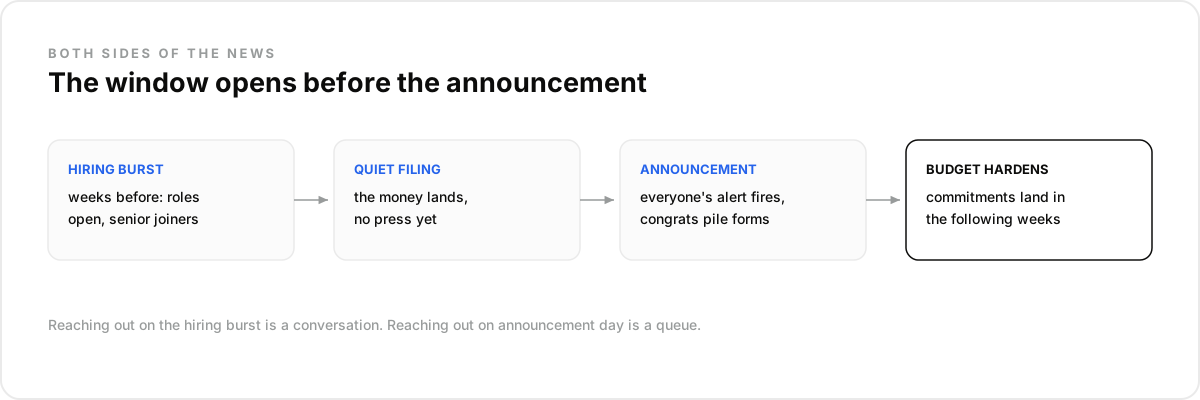
Three tells move ahead of the press release: hiring bursts, senior arrivals, and headcount growth. Companies staff up for the round and after the close, weeks before the announcement, and all three are visible in structured data while the money is still officially quiet.
A twelve-person startup opening five roles is telling the market something. A respected operator joining a small company as VP of Sales says the same thing louder. Growth fields, six-month headcount change, recent hires, make both queryable instead of anecdotal.
The same trail serves every persona that cares about money moving:
- An SDR agent opens the budget conversation on the hiring burst, two weeks before the congratulations pile forms.
- A deal-sourcing agent treats the burst as the earliest confirmation a quiet round is real.
- A recruiting agent flags the newly funded company as the account about to hire twenty people.
These pre-tells are the differentiated window. Reaching out on a hiring burst two weeks before the round is a conversation; reaching out on announcement day is an entry in a very long queue. Our guide to job change signals covers the person-level version of the same logic.
How Do You Wire the Detection Loop?#
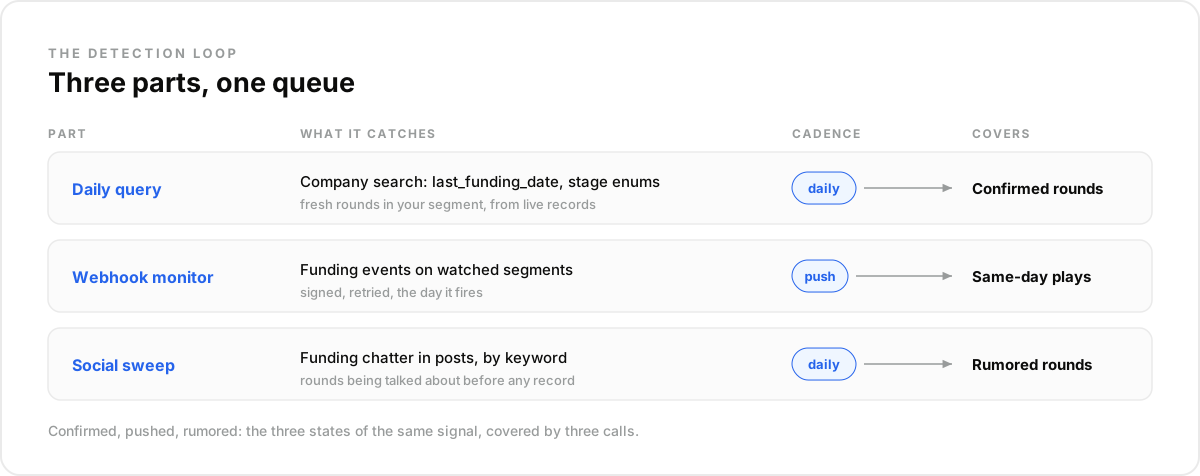
Three parts, all running daily and feeding one queue: a filtered company query for fresh rounds, a webhook monitor for watched segments, and a social sweep for funding chatter. Together they cover confirmed, pushed, and rumored, which is the entire lifecycle of the signal.
The query is the workhorse. Fresh rounds in your segment, straight from live company records:
import requests

response = requests.post(
    "https://api.dataforb2b.ai/search/companies",
    headers={"api_key": "YOUR_api_key", "Content-Type": "application/json"},
    json={
        "filters": {
            "op": "and",
            "conditions": [
                {"column": "last_funding_date", "type": ">", "value": "2026-07-01"},
                {"column": "funding_stage_normalized", "type": "in",
                 "value": ["seed_round", "series_a"]},
                {"column": "employee_count", "type": "between", "value": 11, "value2": 200}
            ]
        },
        "count": 50
    }
)

fresh_rounds = response.json()["results"]
Best for: teams selling into segments where rounds happen weekly and budget windows decide deals. Not for: markets where funding is rare or irrelevant to buying; there, hiring and job-change signals carry the timing instead.
The monitor removes the polling: watch a segment or a founder list, and funding events arrive as webhooks with signed headers and retries. The social sweep catches the third state, rounds being talked about before any record exists, by searching posts for funding language in your category.
The loop runs on live data behind one key. Wire it on the free tier via the pricing page.
What Happens After the Round Lands?#
The account-level news becomes a person-level play. The agent pulls the decision-makers in the buying function through a people search, enriches the two or three who matter for verified work emails, and hands a rep the context: the round, the stage, the hiring picture, the angle.
Concretely: the daily query returns six fresh rounds, the ICP check keeps three, the people search finds nine decision-makers across them, and enrichment runs on those nine only. The rep briefs land before the announcement finishes circulating, each with a verified email attached.
Speed here is the second edge. The budget conversation inside a freshly funded company starts immediately, and the vendors who arrive with something specific in week one are evaluated; the pile that arrives with congratulations in week one is deleted. Same timing, different preparation.
A data layer like DataForB2B keeps that chain, company query, people search, enrichment, webhook, behind a single key on the buying signals API, which is what makes the daily loop a schedule instead of a project.
The Mistake Most Teams Make#
The mistake most teams make is competing at the announcement instead of around it. They subscribe to the same lists, fire the same congratulations, and wonder why the funded company never replies. The signal was real; the timing put them in a crowd.
In our experience the edge is on both sides of the news: the pre-tells, hiring, senior joiners, growth, before it, and disciplined person-level follow-up in the first days after. What surprised us is how empty the pre-announcement window is: almost nobody queries for the round before it is a headline.
How Do You Run the Funding Loop in Claude or Any LLM Agent?#
The detection loop fits in one scheduled conversation. Connect the data layer to Claude over MCP, paste the brief once, and the daily query, the enrichment pass, and the rep briefs run on a schedule you set and forget.
- Create a free account at app.dataforb2b.ai/signup and grab your API key.
- In Claude, open Settings, then Connectors, and add https://mcp.dataforb2b.ai/mcp. The same server plugs into Cursor, VS Code, ChatGPT, or any MCP-enabled agent.
- Paste the brief: "Every morning, find B2B software companies that raised seed or Series A in the last 30 days and enrich two decision-makers per company."
- Turn the working chat into a scheduled routine so it runs daily without you.
The round is public the moment it stops being an edge. Track the trail instead, starting on the pricing page.
Frequently asked questions
- Why are public funding databases late on rounds?
- Because they ingest after the fact: filing or announcement first, then processing, then a refresh cycle. Practitioners building deal-ready lists report going straight to the sources, filings, PR, job boards, precisely because the database copy arrives after the window has a queue in it.
- Which signals precede a funding announcement?
- Hiring bursts, senior arrivals, and headcount growth. Companies staff up around a close weeks before the press release, and both the job postings and the profile changes are queryable in structured data. The announcement usually confirms what the hiring picture already said.
- What does a funding webhook actually deliver?
- An event pushed to your endpoint when a watched company or segment raises: the signal type, the target, and the event data, with a signed header and automatic retries. Your agent reacts the day the round fires instead of rechecking a database on a schedule.
- How long does the post-round window stay warm?
- The budget conversation starts immediately and hardens over the following weeks as commitments land. Treat the first days as the window for specific, relevant outreach, and expect anything generic to drown in the congratulations pile that arrives on announcement day.
- Do you still need Crunchbase if you have a live data layer?
- For funding history and diligence depth, it holds real value; our Crunchbase API review covers where. For timing, a live layer wins: fresh rounds by query, events by webhook, and the people enriched in the same stack.