Best People Data Labs Alternatives 2026: 8 APIs Compared
People Data Labs alternatives for 2026: eight data APIs compared on refresh model, published pricing, search depth and the plan that unlocks a work email.
People Data Labs sells a copy of the graph. Three billion person records, clean APIs, and a refresh cadence measured in months. That is the whole product, and it is why most searches for People Data Labs alternatives start with the same sentence: the data is broad, and it is old by the time my agent reads it.
Builders on Reddit say it plainly. "Good coverage, but the monthly batch refresh is a problem for anything real time." Another: "the search filters are pretty basic." A third vetted it and called the accuracy wildly uneven.
This page compares eight alternatives on published pricing, refresh model, search depth and the plan you need for a work email. Every number comes from a vendor page or docs checked in September 2026, and we say where PDL still wins.
Key Takeaways#
- People Data Labs prices self-serve Person Data from $98 a month for about 350 records, roughly $0.28 a record, with a free tier of 100 records a month and contact fields obfuscated on it.
- PDL refreshes on a batch cadence. Crustdata, Coresignal's API and DataForB2B answer at query time. Apollo, Clay and Prospeo sit in between as platforms or waterfalls.
- Only three of the eight expose funding stage, company growth and job-change signals as native filters.
- Stay on PDL for bulk: flat files, entity resolution, 3B+ records. Leave when the agent needs the answer now.
How Did We Evaluate These Alternatives?#
We scored each vendor on five things a builder can verify before signing: the refresh model (batch or request-time), the published entry price and what it buys, the plan that unlocks a work email, the depth of the search filters, and whether REST is joined by MCP and webhooks. Coverage claims are quoted from the vendor, not tested by us.
Two things we did not score. Match rate, because every published figure is an average across a population that is not yours. And support, because a Reddit thread is not a sample.
The 8 People Data Labs Alternatives at a Glance#
| Vendor | Model | Entry price | Work email | Search filters | Signals | Access | Best for |
|---|---|---|---|---|---|---|---|
| People Data Labs (baseline) | Dataset, batch refresh | $98/moabout 350 records, $0.28 each | Pro planobfuscated on free | BasicElasticsearch-style on enterprise | No | REST, flat files | Bulk datasets, entity resolution |
| 1. DataForB2B | Request-time, per operation | $49/mo3,000 credits, free tier | Every plan1 credit | 60+ people, 40+ company | Job change, funding, posts, jobs | REST, MCP, webhooks | Agents that decide at query time |
| 2. Crustdata | Cached tier, gated live tier | $95/mo lowest tierplan prices not published | Enterprisecontact enrich 1 to 5 credits | Strongpraised on Reddit | Live endpoints, one social network | REST, MCP | Cheap cached discovery at 0.03 credits |
| 3. Coresignal | Datasets plus credit APIs | $49/mo2,500 credits | Pro plan, $49920 credits | Elasticsearch DSL | Jobs data | REST, MCP, flat files | Warehouse-scale ingestion |
| 4. Apollo.io | GTM platform, credits | Free planpaid from $49 per user | Includedcredits per record | UI filters, "too vague" per Reddit | Intent, in-app | REST on Custom plans | Teams that want the UI and the sequencer |
| 5. Clay | Waterfall orchestrator | Free planLaunch from $167/mo annual | Via providerscredits | Depends on provider | Via providers | HTTP API on Growth | Ops teams chaining many providers |
| 6. Prospeo | Contact waterfall | Free creditspaid tiers | Pay on verified only | Contact lookup, not search | No | REST | Top-up layer for emails and phones |
| 7. Explorium | Prepaid packs | $99.99 one-timeexpires 12 months | Included in packs | Firmographic, intent | Partner intent signals | REST, MCP | GTM teams buying enrichment in bulk |
| 8. Bright Data | Datasets and crawling infra | From $250 per 100K records | Not a contact product | You build it | You build it | Datasets, MCP | Engineers running their own pipeline |
Scroll sideways for every column
Two rows carry most of the argument. PDL's $0.28 a record is fair for a copy you keep and query locally. It is expensive for a record you re-buy every month to check whether it changed. That single difference explains most of the migrations in this list.
What Does People Data Labs Actually Cost?#
People Data Labs prices Person Data from $98 a month on its self-serve Pro plan, which buys about 350 person records, or roughly $0.28 each. Company Data starts at $100 for 1,000 monthly records, and IP Enrichment at $95.40. A free plan covers 100 records a month with emails, phones and addresses obfuscated.
Above self-serve sits the enterprise tier, where the bulk datasets live. Those are quoted, and the flat-file business is where PDL's 3B+ records and its people-to-company entity resolution do their best work.
The per-record math is the one to run. Ten thousand person enrichments a month at $0.28 is $2,800. That is fine once. It is a recurring line the moment your use case is "is this still true", because the answer is stored, not fetched.
Why Do Builders Look for a People Data Labs Alternative?#
Three reasons repeat across the threads and the reviews. The refresh cadence, which is monthly on the dataset and makes real-time use cases a poor fit. The search filters, which builders call basic next to the depth an agent needs. And the model itself: you own a copy, so freshness is your job.
One user in r/AI_Agents put the first point in one line: PDL has good coverage but the monthly batch refresh is a problem for anything real time. Another asked for filters beyond title and location and got a shrug.
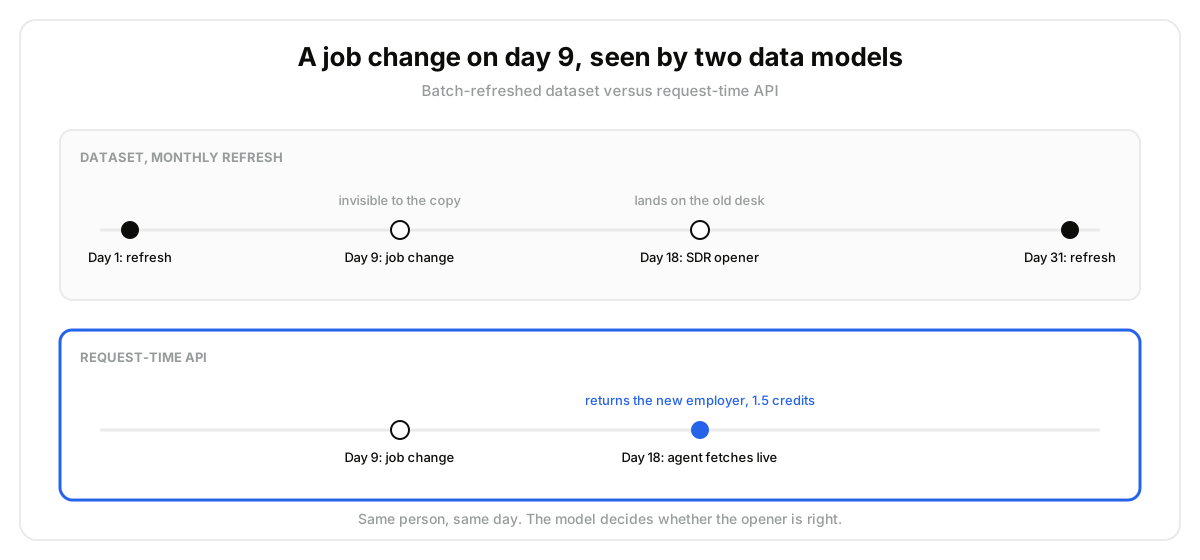
Here is what that looks like in production. A RevOps team enriches 2,000 CRM contacts in the first week of the month. A decision-maker at a target account changes jobs on the 9th. The CRM shows the old employer until the next run, and the SDR's opener lands on a desk the person left three weeks ago.
Live Fetch or Monthly Refresh: Which Model Fits an Agent?#
A request-time model fits an agent because the agent acts at a moment, and the fact has to be true at that moment. A batch model fits a warehouse because a warehouse joins millions of rows and does not care which Tuesday they were collected on. Neither is wrong. They answer different questions.
Our own API runs the first model. A profile fetch is live, 1.5 credits, and a verified work email is 1 credit on every plan including the free tier. The equivalent on a dataset vendor is a stored record plus a refresh you schedule and pay for.
One call shows the shape:
curl -X POST 'https://api.dataforb2b.ai/enrich/profile' \
  -H 'api_key: YOUR_API_KEY' \
  -H 'Content-Type: application/json' \
  -d '{
    "profile_identifier": "https://www.linkedin.com/in/the-contact-you-track",
    "enrich_profile": true,
    "enrich_work_email": true
  }'
The response is the person's current role and a work email, at 2.5 credits, about four cents on the $49 plan. Run it on the 2,000 contacts above and the batch costs 5,000 credits, inside the $150 plan, with no month-old copy in between.
The trade-off is honest. There is no flat file to download here. If your job is a 50-million-row join in Snowflake, PDL or Coresignal is the right counter and this API is not.
How Do the Search Filters Compare?#
Search depth decides whether your agent can ask the question it has, or only the question the vendor anticipated. PDL's self-serve search covers title, company, location and a handful of profile fields. The enterprise tier opens Elasticsearch queries, which is powerful and yours to write.
Per-operation search here runs on 60+ people columns and 40+ company columns as native filters: current company size and funding stage, years in the current position, past companies, skills, languages, certifications, and on the company side employee growth over 1, 6 and 12 months, last funding amount and date, and investor.
The difference shows up in the questions an agent can ask. "RevOps leads at 51 to 200-person SaaS companies that raised a Series A in the last year" is one query here. On a basic filter set it is a title search followed by a spreadsheet.
What surprised us was how often the filter gap, not the freshness gap, was the reason a team left. Freshness is the complaint people post. Filters are the thing they hit on Tuesday.
Where People Data Labs Still Wins#
Stay on People Data Labs when the job is bulk. The 3B+ record dataset, the flat-file delivery and the people-to-company resolution are built for market mapping, training data, analytics over time and any pipeline where your team wants to own a copy and join it locally.
Stay too if you already run the enterprise tier and wrote your Elasticsearch queries. The search is deep once you pay for it, and rewriting a working pipeline for a freshness gain you may not need is a real cost.
And if the record you enrich changes slowly, industry codes, headquarters, founding year, a monthly copy is fine and cheaper than a live call. Firmographics do not change on a Tuesday.
The Other Alternatives, Briefly#
Crustdata is the closest in spirit to a live model, with dedicated live endpoints and search filters builders praise. The gates sit early: live people data, contact enrichment and social posts require plans that start with a sales conversation, and the cheap tier reads a cache. Our Crustdata comparison has the credit table.
Coresignal is PDL's most direct rival on the dataset model, with 895M+ profiles, flat files and credit APIs from $49. Contact enrichment opens at the $499 Pro plan at 20 credits a record. Details in the Coresignal comparison.
Apollo.io is a finished application with a database inside it: sequencer, dialer, Chrome extension. The API sits on Custom plans. Right if your team wants the UI. Wrong if your agent is the UI.
Clay is not a data vendor but a waterfall that calls many of them, PDL included. Right for ops teams that want to chain providers in a table. Wrong as a database, for the reasons in our Clay comparison for developers.
Prospeo and its peers FullEnrich and Findymail are contact waterfalls that charge only when an email verifies. They top up a list; they do not search one.
Explorium sells prepaid data packs from $99.99 that expire after twelve months, aimed at GTM teams rather than builders. See the Explorium comparison.
Bright Data is infrastructure: datasets from $250 per 100K records and crawling tools. The most flexible option here and the most work to keep fresh.
How Do You Run a Side-by-Side Test?#
You run it by taking 100 profiles you already trust, enriching them on PDL and on a request-time API the same afternoon, and scoring three things: how many current employers were right, how many work emails came back, and what the batch cost on the plan it forced you onto.
- Create a free account on app.dataforb2b.ai/signup and pull an API key. Use the PDL free tier for the other side, knowing its contact fields are obfuscated.
- Connect the MCP server in Claude under Settings, then Connectors, at https://mcp.dataforb2b.ai/mcp. The same server works with Cursor, VS Code, ChatGPT and any MCP-compatible agent.
- Paste a prompt that runs the test: "Take these 100 LinkedIn profiles of RevOps leads, refresh each one's current company and title, add a verified work email where one exists, and flag every profile whose employer changed since the CSV date."
- Turn the conversation into a scheduled routine, weekly, so the freshness score is measured over a month rather than one afternoon.
The mistake most teams make is comparing entry prices. $49 against $98 says nothing. Compare what one month of your real workflow consumes, and which plan that volume forces you onto. Start on the free tier on the pricing page and run the 100.
PDL built a very good copy of the graph. The question is whether your agent needs a copy or an answer. If it is the answer, grab a key on the pricing page and test the 100 profiles this week.
Frequently asked questions
- Who are People Data Labs' main competitors?
- Coresignal and Bright Data compete on the dataset model, selling flat files and credit APIs. Crustdata and per-operation APIs compete on request-time enrichment, answering each call live. Apollo and Clay compete for the same budget as a platform and a waterfall rather than a data vendor. Which one is the real competitor depends on whether you want a copy or an answer.
- How much do People Data Labs cost?
- Self-serve Person Data starts at $98 a month for about 350 records, roughly $0.28 a record, Company Data at $100 for 1,000 records, and IP Enrichment at $95.40. Bulk datasets and higher limits sit on enterprise plans quoted by sales. A free plan covers 100 records a month with contact fields obfuscated.
- Is People Data Labs free?
- Partly. The free plan returns up to 100 records a month, but emails, phones and addresses are obfuscated, so it is a schema preview rather than a working tier. For a free tier that returns usable contact fields, a per-operation API here includes a verified work email at 1 credit on every plan, free tier included.
- Is People Data Labs good for real-time enrichment?
- Not by design. PDL is a dataset vendor whose records refresh on a batch cadence, so a job change between refreshes stays invisible until the next run. Builders on Reddit name this as the main limit for agent workloads. A request-time API returns the current employer at the moment of the call, which is the fit for agents acting now.
- What is the best People Data Labs alternative for AI agents?
- For an agent that decides at request time, a per-operation API with live profile fetches, contact fields on every plan and MCP access is the closest fit: DataForB2B or Crustdata's live tier, depending on budget and gates. For bulk ingestion into a warehouse, Coresignal is the closest like-for-like alternative to PDL.