Clay Alternative for Developers: Own the Data (2026 Guide)
Looking for a Clay alternative for developers? Clay's 2026 Actions and Data Credits pricing, the Growth-plan API gate, why it fails as a database, and the fix.
Clay is the best GTM spreadsheet ever built. It is also the tool developers keep trying to turn into a database, and that is where it breaks.
On r/gtmengineering, an agency mapping a real estate TAM hit the wall: lookups past 300 records failed, and enriching 1,000 accounts at once broke the table. The best reply was blunt. Clay was never built to be the database. Pull the data from an API, store it in Postgres, and let Clay read from that.
That reply is the whole shape of a Clay alternative for developers. Not a prettier table. A data layer you own. This guide covers Clay's 2026 pricing, where the API gates sit, and when a per-operation B2B data API is the better fit.
Key Takeaways#
- Clay meters two things now. Actions for platform work, Data Credits for data. A full record runs 6 to 20 credits.
- The HTTP API sits on Growth. From $446 a month annual. Free and Launch cannot call it.
- Clay is not a database. Practitioners report tables failing past 300 lookups. Keep raw data in Postgres.
- A data API gives you search, posts, and webhooks by request. No table, no row limit, every plan.
What Is Clay?#
Clay is a GTM orchestration platform that enriches spreadsheet rows through 150+ data providers, runs AI web research with Claygent, and pushes results into CRMs and sequencers. It is a table you build workflows in. The data comes from a marketplace of vendors, and every row you enrich costs both an action and some credits.
It is genuinely good at that job. The trouble starts when a developer asks it to be something else.
What This Comparison Is Not#
This is not a list of ten Clay lookalikes. It compares a table-first orchestration tool with an API-first data layer, so a builder can decide which one their agent should sit on. Three neighbours get confused with both, and none of them is the same thing.
- Not an all-in-one platform. Apollo and ZoomInfo ship a UI, dialers, and sequences. Clay orchestrates other people's data. A data API is a raw pipe you build on.
- Not a workflow builder. n8n and Zapier move data between apps on triggers.
- Not a cached dataset. Crustdata and Coresignal sell cheap cached discovery with gated live endpoints. We covered that trade in the Crustdata alternative guide.
What Does Clay Actually Cost in 2026?#
Clay moved to a two-meter model in March 2026: Actions for platform work and Data Credits for data. Launch starts at $167 a month annual, Growth at $446, and a fully enriched record typically costs 6 to 20 Data Credits. Top-ups carry a 30% premium. The free plan caps tables at 200 rows.
The published grid:
- Free: 500 actions and 100 data credits a month, 200 rows per table, no phone enrichment, no HTTP API.
- Launch: $167 a month annual ($185 monthly), 15,000 actions, 2,500 credits, 50,000 rows per table. Still no HTTP API and no CRM integrations.
- Growth: $446 a month annual ($495 monthly), 40,000 actions, 6,000 credits. Adds HTTP API integrations, CRM sync, webhooks, web intent.
- Enterprise: 100,000+ actions, bulk runs above 50,000 records, SSO.
The number that matters is 6 to 20 credits per full record, from Clay's own docs. One reviewer described burning through $700 in two weeks on enrichments that came back wrong.
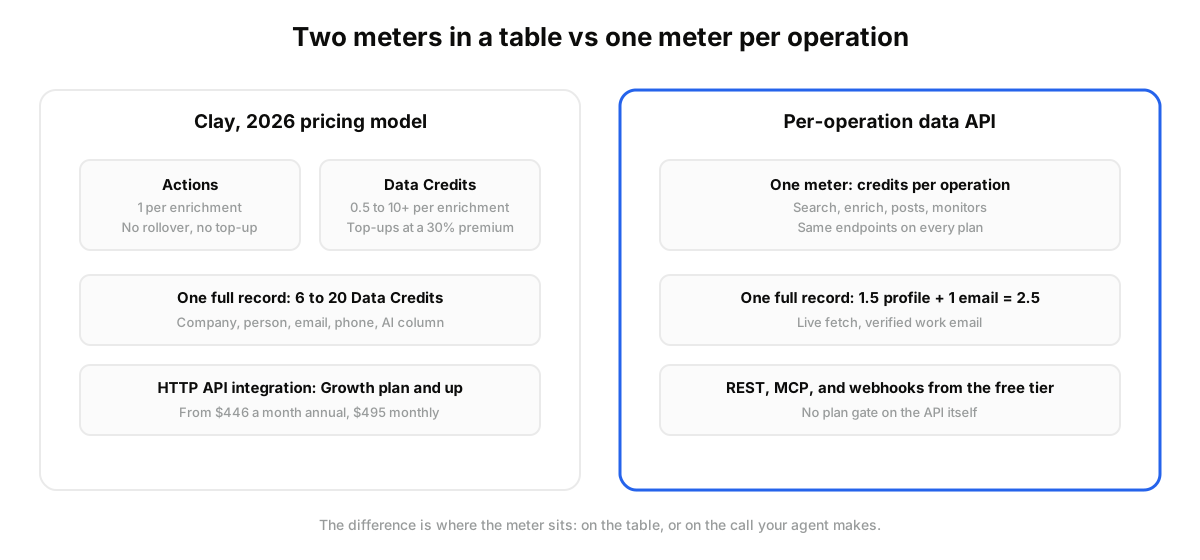
On a per-operation data API the same record is a live profile fetch plus a verified work email, 2.5 credits, on every plan including the free tier. The rest of the difference is architectural, not arithmetic.
Where Do Clay's API Gates Sit?#
Clay's HTTP API integration is a Growth feature, so the two lower plans cannot call an external endpoint from a table. The newer Agent Plugin, Public API, and CLI are in open beta on all plans, with search capped at 50 results per request and 100 a month on Free.
Paid self-serve plans lift that to 10,000 results per request and 1 million a year. The beta uses the same credits as in-product work, and credit budgets are not available through it yet, so nobody can put a spend ceiling on an API run today.
The objection is obvious: "surely the API beta closes the gap". It closes the access gap. It does not change what comes back: marketplace data priced in credits, bounded by search limits, shaped for a table.
Why Is Clay Not a Database?#
Clay stores rows so it can run enrichment on them, not so you can query them at volume. Practitioners on r/gtmengineering report lookups failing past 300 records and bulk enrichment of 1,000 accounts breaking a table. Bulk above 50,000 records is an Enterprise feature by design.
The TAM-mapping agency in that thread had a client who wanted Clay as the central database. Real estate, a long tail of tiny firms, two to four contacts per account. It kept falling over.
One reply laid out the fix. Pull companies and contacts from a data provider's API. Drop them into Postgres or BigQuery. Batch the pulls from Claude Code on a schedule so nothing times out at 300. As another practitioner put it: "Clay isn't a database. Move the raw data to Postgres, batch through Clay, write results back."
Search People and Search Company return up to 1,000 rows per request with 40+ filter columns each. Your database holds the truth. Clay, if you keep it, becomes a view.
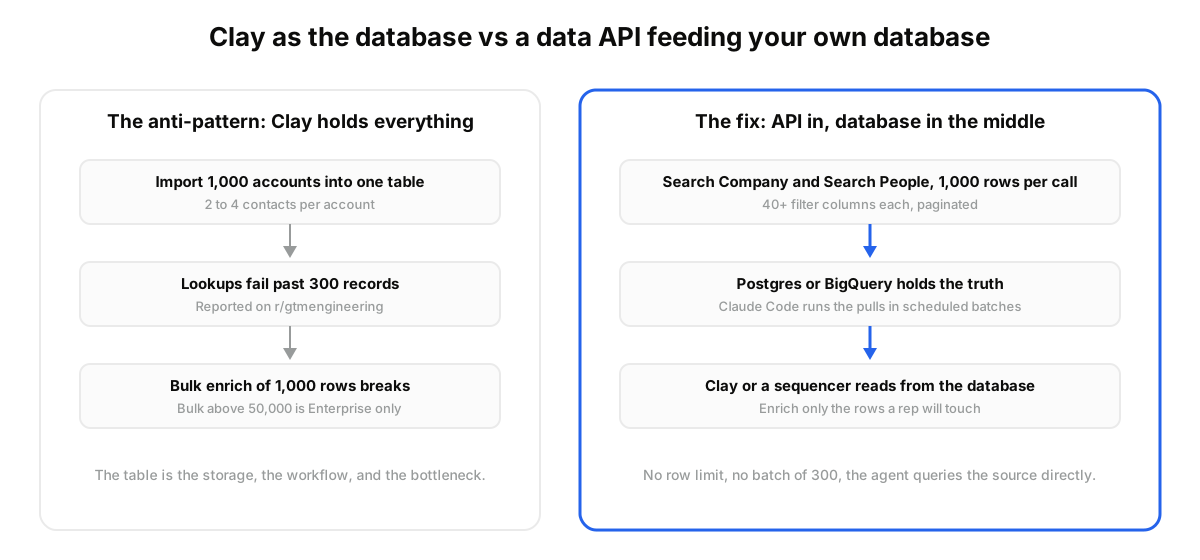
Here is that agency's TAM build. Search Company with industry real estate, employee_count between 11 and 200, country US. Paginate into Postgres. Then Search People per company id with current_title in the buying titles, four per account. Enrich the ones a rep will touch. Not the rest.
Builders can wire this up against the live API today. Start on the free tier on the pricing page.
What Can a Data API Do That a Clay Table Cannot?#
Three things, and none of them fit in a row: post search with engagers attached as leads, a query that finds people asking for a tool, and webhooks that fire when a signal happens. A table waits for you to open it. An endpoint answers when the agent asks.
Posts first. Search Social Posts reads LinkedIn, X, and Reddit by keyword, and with reactions and comments included, every engager comes back as a lead with a profile URL. Someone who commented on a competitor's launch is warmer than any waterfalled list.
The second use is hotter. Search for posts that say "anyone know a tool for" in your category. That author is asking for a solution right now. Enrich them first. Clay has no native equivalent.
Then signals. Clay sells job change signals from Launch up, inside a table. A Monitor here is three fields: signal, watch, url. Signal is job change, funding, or founder moves. Url is your webhook. Events arrive signed, with five retries.
A two-rep team at a Series A dev-tools startup runs it this way. A Monitor watches 300 champions from closed-won deals for job changes. When one fires, the agent enriches the new role, checks the company against the ICP, and drafts an opener. The full pattern is in how to build a signal-based prospecting list.
This fits teams whose agent needs fresh data at request time. If you batch-enrich a static list once a quarter and a human reviews every row, a table is the right shape.
The Case for Staying on Clay#
Clay wins when the humans doing GTM work live in tables and the value is orchestration, not data ownership. Waterfalls across 150+ providers, Claygent research, one-click CRM sync, and the largest GTM-engineer community in the category are real advantages. A small sales team with no engineer should stay.
The trade-off is plain. You trade a data layer your agent controls for a UI that non-technical teammates can operate on Monday morning.
One r/sales_intelligence poster said Clay felt like overkill; they wanted good contacts in the CRM without a part-time engineer maintaining it. The reply that stuck: most people use about 20% of Clay, so a simpler tool that does that 20% well is the right trade.
If your 20% is the table, keep Clay. If it is search, enrichment, and signals called from code, you do not need the table at all.
How Do You Run a Side-by-Side Test?#
Pick one workflow that hurts in Clay today, rebuild it against the API from Claude, and compare rows returned, cost, and time to first result. Ten minutes gets you a live search with no table to set up and no waterfall to configure.
- Create a free account at app.dataforb2b.ai/signup. The free tier is permanent.
- Connect the MCP server in Claude: Settings, Connectors, add https://mcp.dataforb2b.ai/mcp. The same server works with any MCP-compatible agent, including Cursor, VS Code, ChatGPT, and custom agents. Setup is in the MCP servers for B2B data guide.
- Paste a prompt that runs the TAM build: "Find 200 real estate companies in the US with 11 to 200 employees, then for each one find up to 4 people with a title containing Broker, Partner, or Director of Operations. Write everything to my Postgres table tam_realestate. Do not enrich emails yet."
- Turn the conversation into a scheduled routine so the table refreshes weekly and the agent only enriches the accounts a rep touches.
When we tested this shape against a Clay table doing the same job, the difference was not speed. The API never asked us to split the run into batches of 300.
See how the data layer fits your agent. Grab an API key on the pricing page.
Clay is a fine place to work on data and a bad place to keep it. Put the records in a database your agent can query. Start on the free tier on the pricing page.
Frequently asked questions
- How much does Clay cost in 2026?
- Clay's 2026 model has a free plan, Launch from $167 a month annual ($185 monthly), Growth from $446 annual ($495 monthly), and Enterprise on quote. Plans meter Actions for platform work and Data Credits for data. A fully enriched record typically uses 6 to 20 Data Credits.
- Does Clay's HTTP API require a paid plan?
- HTTP API integrations inside tables are a Growth feature, from $446 a month annual. The separate Agent Plugin, Public API, and CLI are in open beta on all plans, but Free is capped at 50 search results per request and 100 a month, and credit budgets are not yet available through the API.
- Can you use Clay as a database?
- Not reliably. Practitioners report lookups failing past 300 records and bulk enrichment of 1,000 accounts breaking a table; bulk above 50,000 records is Enterprise-only. The common fix is to pull data from a provider's API into Postgres, batch from Claude Code, and let Clay read from it.
- What is the best Clay alternative for developers?
- For builders who want to own the data, DataForB2B is the closest fit: search over 800M+ profiles and 75M+ companies with 40+ filters each, per-operation enrichment, posts search with engagers as leads, and webhook monitors, through REST and MCP on every plan. Clay remains the better UI for non-technical teams.
- Does DataForB2B replace Clay?
- It replaces the data and signal half. Search, enrichment, post engagers, and job-change or funding webhooks come straight from the API, so an agent never needs a table. It does not replace Clay's orchestration UI, waterfalls, or Claygent. Many teams keep Clay as a view on a database the API fills.