Harmonic.ai Alternative: Real Costs, Gates, and Fit (2026)
Looking for a Harmonic.ai alternative? What Harmonic publishes, the estimated $25k floor and add-ons, and how to run funding-to-founder sourcing by API.
Harmonic is probably the best startup discovery engine you can buy. It is also one you cannot try.
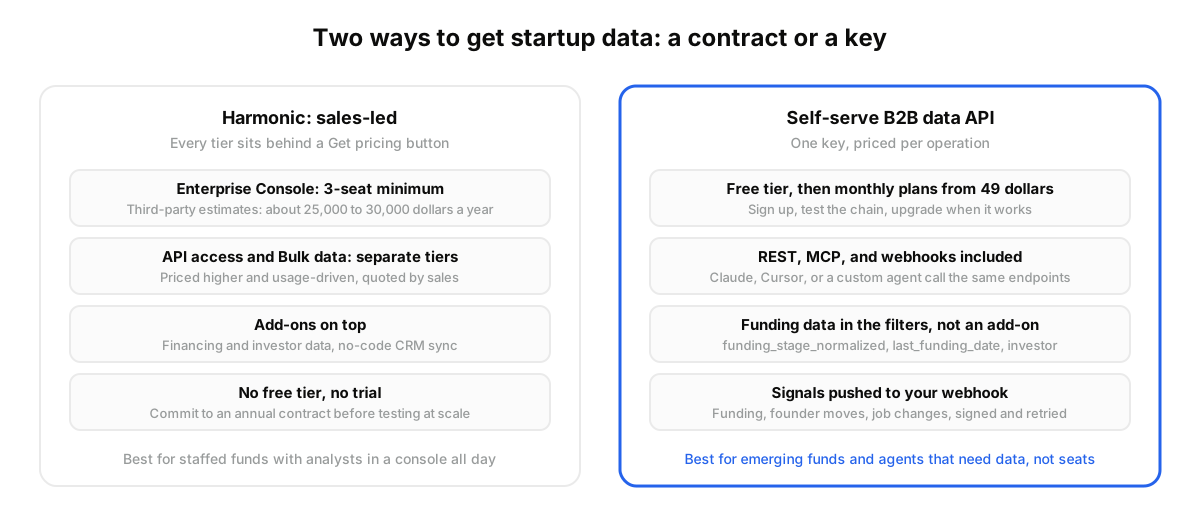
The pricing page lists three tiers, Enterprise Console, API access, and Bulk data. Every one sits behind a "Get pricing" button. Third-party reviews in 2026 put the entry ticket near $25,000 a year, with a three-seat minimum. No free tier. No trial.
That works for a fund with analysts. It is a wall for a solo GP or a builder wiring deal sourcing into an agent. So the real question behind a Harmonic AI alternative search is simple: do you need a console with seats, or a data API your own agent can call?
Key Takeaways#
- Harmonic does not publish prices. Its own PitchBook comparison says so. Third-party estimates land near $25,000 to $30,000 a year, 3-seat minimum, no trial.
- Financing data and CRM sync are add-ons. Investor data is extra on Console and Bulk; no-code CRM sync is extra on API access.
- The sourcing chain is reproducible with filters. Funding stage and date on companies, founder titles on people, then a work email.
- Signals can arrive as webhooks. A funding or founder-move monitor replaces the daily console check.
What Is Harmonic?#
Harmonic is a startup intelligence platform that tracks 35 million companies and 195 million people, refreshes priority companies daily on a cohort cycle, and sells that data through a console, an API, and bulk warehouse delivery. Its buyers are VC funds, corporate development teams, and GTM teams whose ICP is startups.
Two things set it apart. Coverage at formation: Harmonic pulls from legal filings, founder submissions, and data shared by venture firms and accelerators, so companies show up before public announcements. And Scout, an AI research agent that turns a thesis into a market map from one query.
It also ships developer surfaces: a REST API, GraphQL, a native Affinity integration, and a hosted MCP server with 40+ tools.
What Does Harmonic Actually Cost?#
Harmonic publishes no prices. Its pricing page shows three tiers behind "Get pricing" buttons, and its own Harmonic vs PitchBook page states that neither company publishes pricing publicly. Third-party reviews in 2026, including prospeo.io and jaymountconsulting.com, estimate a minimum commitment around $25,000 a year, roughly $10,000 per seat with a 3-seat minimum.
Treat those as estimates, not a quote. What is verifiable sits on the pricing page:
- Enterprise Console: seat-based access to all web products. "Financing and investor data" is an add-on.
- API access: enrich any company or person, discover new ones. "No-code sync to your CRM" is an add-on.
- Bulk data: every record, refreshed weekly, delivered to S3, BigQuery, or Snowflake. Financing data is an add-on here too.
The same reviews report no free tier and no trial. In our experience, that detail decides most evaluations. You commit before you test.
Who Is Harmonic Built For?#
Harmonic is built for teams that source deals as a full-time job: institutional VC funds, growth equity, and corporate development groups with analysts who live in a console all day. If your firm has three or more seats to fill and a sourcing-to-IC workflow to run, the product fits the way it was designed.
It helps to say what Harmonic is not, by naming the neighbours:
- Not PitchBook. PitchBook is the deal, valuation, fund, and LP database. Harmonic positions itself as the earlier-stage, people-heavy discovery engine.
- Not CB Insights. CB Insights leans toward market mapping and trends. Harmonic leans toward finding companies and the people inside them.
- Not Crunchbase Pro. Crunchbase is self-serve research at a per-user price. Harmonic is an enterprise contract.
The gap on the other side is the builder: a solo GP, a scout program, or a team embedding sourcing into an agent needs the data, not the seats.
How Do You Source Deals Without a Console?#
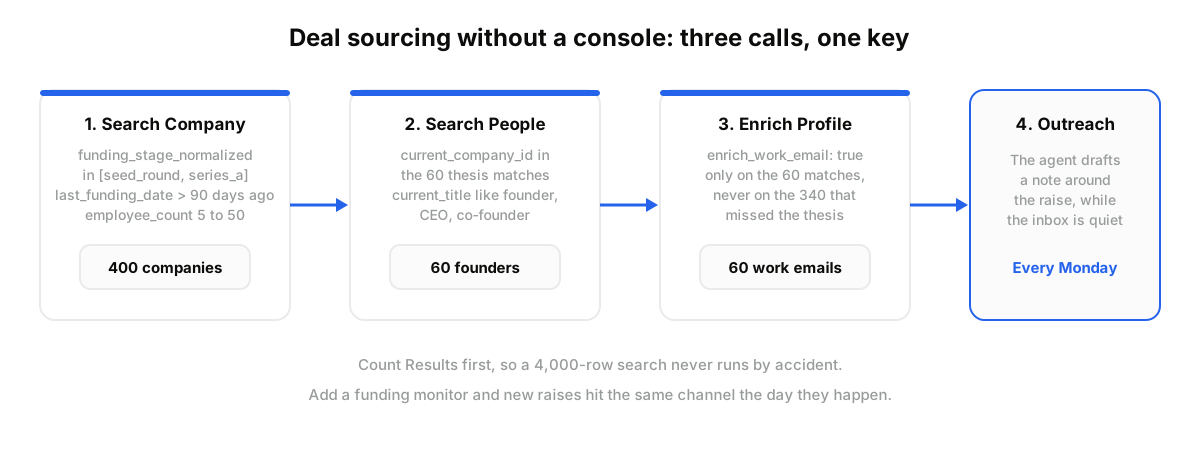
You source deals without a console by chaining three API calls: a company search on funding filters, a people search for founders at those companies, and a profile enrichment for a work email. Each step is a POST request or an MCP tool, so an agent can run the whole chain on a schedule.
Take a two-partner pre-seed fund in Berlin writing eight checks a year. They want European seed and Series A companies that raised in the last 90 days.
Step one is Search Company. Filters: funding_stage_normalized in [seed_round, series_a], last_funding_date greater than 90 days ago, country_iso_code in [DE, FR, NL], employee_count between 5 and 50. Count Results first, so nobody runs a 4,000-row search by accident.
The search returns about 400 companies. The agent scores them against the thesis and keeps 60.
Step two is Search People on those 60 current_company_id values, with current_title like "founder", "CEO", or "co-founder". Step three is Enrich Profile with a verified work email for the 60 founders. Not the 340 companies that missed.
An emerging fund on r/venturecapital asked this summer whether to pick PitchBook, CB Insights, or Harmonic. The most useful reply, paraphrased: Harmonic is the affordable pick for sourcing and signal tracking at that size, maybe paired with Crunchbase Pro. Another said early-stage funds should worry about winning 20% of the round instead.
Both point the same way. At that stage, the job is a filtered list plus a warm email, weekly. A data problem, not a seat problem.
The whole chain runs on one API key and a free tier. Grab one on the pricing page and try the Berlin query against your own thesis.
How Do You Catch Founders Before the Round?#
You catch founders before the round by searching people, not companies. Someone who left a target company recently, shows no current employer, or carries a headline like "stealth" or "building something new" is a founder before any registry lists a company. Monitors then push the moment a raise or a move happens.
This is the play Harmonic markets hardest, and it earns the claim: filings and founder submissions give it companies at formation. A people-filter version covers a different slice of the same ground.
A corporate development analyst at a London fintech runs it like this. Search People with past_company in a list of 40 payments companies, is_currently_employed equal to false or keyword like "stealth", and years_in_current_position under one year. Yesterday's Head of Risk at a neobank, now "working on something new", is on the list before a domain exists.
The mistake most teams make is polling that search every morning. Monitors replace the loop. One POST to /monitors with a signal (funding, founder moves, job change), a watch list, and a webhook url. Events arrive signed with an HMAC header and retry five times with backoff. A missed delivery is not a missed deal.
When Is DataForB2B the Better Fit?#
DataForB2B is the better fit when your sourcing runs inside an agent or a product rather than a console, when you need to test before you commit, and when the people layer matters as much as the company layer. It is self-serve, with monthly plans from $49 and a permanent free tier, over REST, MCP, and webhooks.
Best for: emerging funds and solo GPs who need a weekly filtered list and a warm email; builders shipping a deal-sourcing agent, where data has to be a request, not a dashboard; teams that want funding and founder-move signals pushed to a webhook.
The trade-off is honest. You swap a finished research workspace and Scout for raw data your agent controls. You write the scoring. You own the CRM sync. If nobody on the team wants to touch a filter, that is a cost.
See what one key covers. Start on the free tier and run the stealth-founder search before you decide.
The Case for Staying on Harmonic#
Stay on Harmonic if you have three or more seats, analyst headcount, and a sourcing process that ends in an IC memo. Its formation-stage coverage from filings and founder submissions, its partner data from venture firms and accelerators, Scout, and weekly bulk delivery to your warehouse are things a per-request API does not replace.
On contact data, be fair to both sides. One 2026 reviewer calls contact information a consistent gap; Harmonic's own blog says its people database provides email addresses for most contacts. Test it on your own list before either claim decides.
How Do You Run a Side-by-Side Test?#
You run a side-by-side test by picking one thesis, running the funding chain through an MCP-connected agent, and comparing the founder list against what your current tool returns for the same week. It takes an afternoon, costs a handful of free-tier credits, and answers the question with your data, not ours.
- Create a free account at app.dataforb2b.ai/signup and copy the API key.
- In Claude, open Settings, then Connectors, and add the MCP server at https://mcp.dataforb2b.ai/mcp. The same server works with any MCP-compatible agent: Cursor, VS Code, ChatGPT, or a custom one.
- Paste a prompt like: "Find seed and Series A companies in Germany, France, and the Netherlands that raised in the last 90 days with 5 to 50 employees. Keep the 60 that best match a B2B fintech thesis, find the founder or CEO at each, and return a verified work email with a one-line reason to reach out."
- Turn the conversation into a scheduled routine that runs every Monday, then add a funding monitor on your watchlist so new raises hit the same channel the day they happen.
The chain drops straight into the deal-sourcing agent guide. The funding-signals article covers the monitor side, and the Crunchbase API review is the read if your current tool is Crunchbase. Product detail lives on the VC data API page.
5,000 a year minimum, roughly
Harmonic earns its reputation, and a staffed fund should keep it. If your sourcing lives in an agent and your budget lives in a spreadsheet, wire the chain up first. Get an API key on the pricing page and let the next 90 days of raises come to you.
Frequently asked questions
- How much does Harmonic.ai cost?
- Harmonic does not publish prices. Its pricing page gates Console, API access, and Bulk data behind "Get pricing", and its own PitchBook comparison confirms neither publishes pricing. Third-party reviews in 2026 estimate about $25,000 a year minimum, roughly $10,000 per seat with a 3-seat minimum.
- Does Harmonic have a free trial or free tier?
- No, according to third-party reviews in 2026. Harmonic is sold through a demo and a custom quote, with no self-serve signup, no free tier, and no free trial. You commit before testing at scale. A self-serve API with a free tier lets you run the same sourcing chain first.
- Does Harmonic offer API access?
- Yes. API access is one of Harmonic's three tiers, covering enrichment of any company or person and discovery of new ones, with no-code CRM sync sold as an add-on. Public documentation lists a REST API, a GraphQL endpoint, and a hosted MCP server with 40+ tools. Pricing is quoted by sales.
- What is the best Harmonic alternative for an emerging fund?
- For a fund without analyst seats, DataForB2B is the closest fit: funding-stage and funding-date filters on 75M+ companies, founder search across 800M+ profiles, verified work emails, and funding or founder-move webhooks, self-serve with a free tier. Pair it with Crunchbase Pro for a browsable research view.
- What is the difference between DataForB2B and Harmonic?
- Harmonic is a startup intelligence console with Scout, network mapping, bulk warehouse delivery, and formation-stage coverage from filings, sold as an enterprise contract. DataForB2B is a B2B data API your agent calls directly, covering companies, people, jobs, posts, and signals over REST, MCP, and webhooks, priced per operation.