How to Source Deals with Claude for VCs in 2026
How to source deals with Claude: build a founder-moves monitor and enrich_profile workflow that flags stealth founders before Crunchbase or AngelList do.
Most deal-sourcing tools watch companies. That's backwards.
A company doesn't move until a round closes, a hire lands, or a press release ships. By the time it shows up in a search, three other funds already called the founder.
The signal that actually moves first is a person. A VP quits. A staff engineer's title goes vague. A known operator vanishes from a well-known payroll and turns up nowhere on Crunchbase.
That's the gap this piece closes. Here's how to source deals with Claude by watching people, not companies. The method: an MCP connector, a founder-moves monitor, and a profile enrichment call that confirms the stealth title before anyone else sees it.
No enterprise sales deck. Just the filters, the signal, and the workflow.
Key Takeaways#
- Founder moves signal a deal before funding data does; a stealth title beats a press release.
- Chain a founder-moves monitor into enrich_profile to confirm who left and where they landed.
- Funding-stage, investor, and growth filters build a narrower watchlist than a Crunchbase search alone.
- Claude runs the whole chain through the MCP connector, with no separate dashboard needed.
What Is a Founder-Moves Signal?#
A founder-moves signal is a monitor event that tracks, flags, and timestamps a known operator's job change. It fires the moment someone leaves a tracked company or list.
No round has to close first. No press release has to exist. The event carries a name, a prior title, and whatever new title now shows on their profile.
The catalog behind it isn't just founder moves. A GET request to /signals lists roughly a dozen event types, including funding and job change. Founder moves is one entry, not a special mode.
The catalog sits behind one provider, DataForB2B, but the mechanics matter more than the brand name.
This matters for trust, too. Claude doesn't guess who moved where. The monitor fires from indexed data, not a language model's memory.
Why Watch People Instead of Companies?#
People change jobs before companies change filings. A company only shows up in a search index once it has a domain, a headcount, and often a funding record.
A person shows up the day they edit a title. Watching the person catches the gap between those two moments, and that gap is where uncontested deal flow lives.
Say a seed fund tracks infrastructure talent leaving well-funded companies. A generic company search misses this entirely. The new company doesn't exist in any database yet.
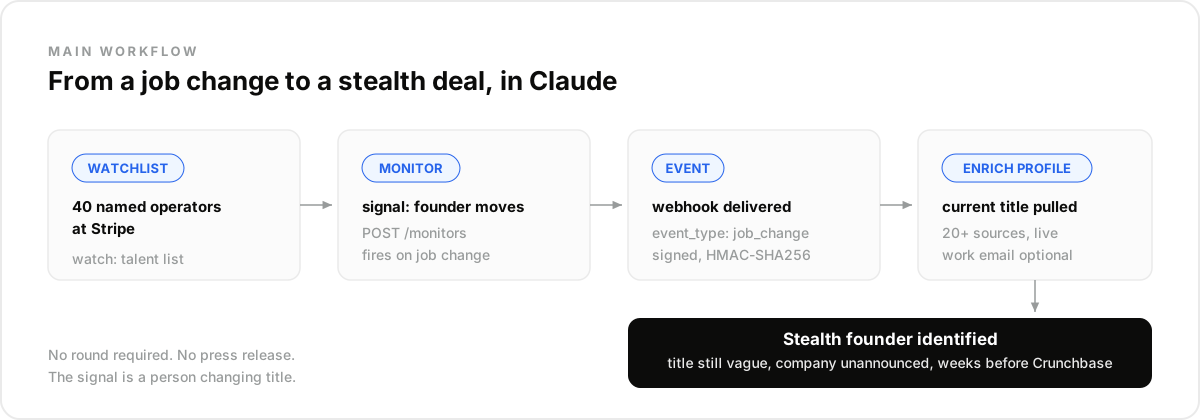
Set a monitor with signal founder moves, watching forty named engineering leaders at Stripe. Three weeks later, an event fires. A former Stripe staff engineer now lists a title of "building something new," no company attached. enrich_profile confirms a personal domain email and a founder-shaped bio, weeks before any filing exists anywhere.
That's a warm lead before Crunchbase even has a company page to index. The fund can reach out while the founder is still deciding on a name.
Worth naming as a trade-off: stealth-title monitoring produces more noise than a funding alert. Plenty of people who leave a job just want a break, not a company. You trade some false positives for weeks of lead time.
Try this on one list before scaling to a full thesis. The pricing page covers the free tier and what a monitor costs to run.
How Do You Confirm a Stealth Title Before It's Public?#
Confirming a stealth title takes two calls, chained together. First, a monitor on the founder moves signal watches a list or a single profile for a change event. Second, enrich_profile pulls the current title, company, and any public signal of what they're building, aggregated from more than 20 sources.
- Build a watchlist: named founders, past operators, or an entire company's alumni.
- Create the monitor, with signal set to founder moves and watch pointed at that list.
- Wait for the event envelope: signal, event_type, target, data, delivered by webhook.
- Call enrich_profile on the target to confirm the current, often vague, title.
Every event carries an X-Webhook-Signature header, signed with HMAC-SHA256. If your endpoint drops briefly, delivery retries five times with backoff. Nothing gets guessed. Nothing gets skipped.
Other Signals That Strengthen the Watchlist#
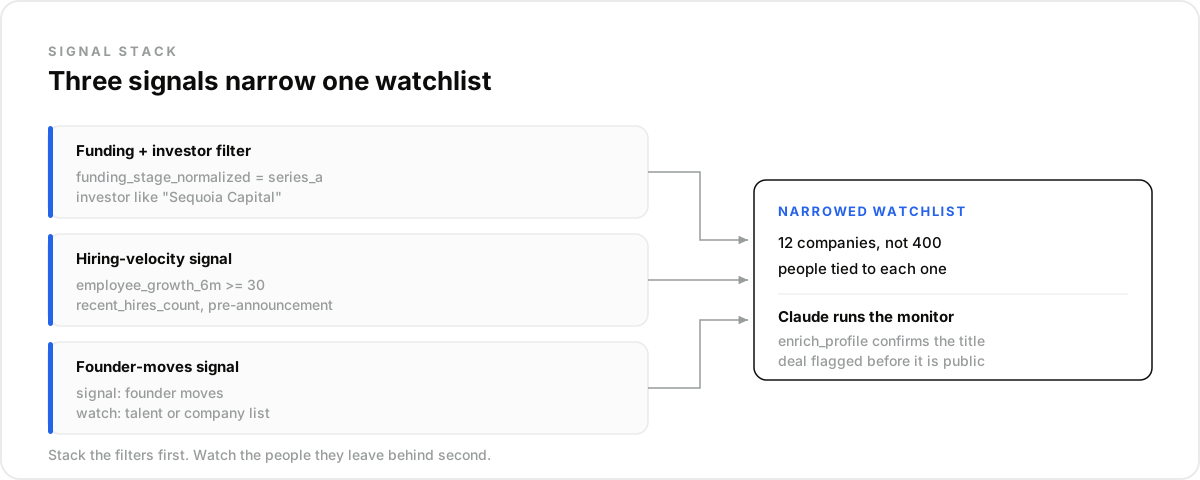
Founder moves works best stacked with two other filters. A funding-stage and investor filter narrows the company list before you ever watch a person. Growth fields flag hiring before any of it becomes a press release. Shared-investor overlap gives you a warm path into the founder's own network.
A generalist analyst can't read every filing by hand.
Filter search/companies for funding_stage_normalized equal to series_a, investor like "Sequoia Capital," and employee_growth_6m at or above 30. Feed that narrowed list into a funding monitor. The analyst now tracks twelve companies instead of four hundred, and gets a webhook the day a new round posts.
Coverage stays wide. Reading time drops to twelve names, not four hundred.
POST https://api.dataforb2b.ai/search/companies
{
  "filters": [
    { "field": "funding_stage_normalized", "operator": "=", "value": "series_a" },
    { "field": "investor", "operator": "like", "value": "Sequoia Capital" },
    { "field": "employee_growth_6m", "operator": ">=", "value": 30 }
  ]
}
Shared-investor overlap works differently. If a portfolio company shares a backer with a target, that backer becomes a warm intro instead of a cold one.
These filters sit on the same data layer behind the VC data API filter set.
Once the filters are dialed in, point the same monitor at your own thesis. Compare plans on the pricing page.
What This Workflow Is Not#
This workflow is not a verification system, a chatbot, or a finished deal-sourcing product with its own interface. It borrows one signal, one enrichment call, and an agent that knows how to chain them in order. Nothing about it replaces judgment. It just moves the moment you get to use that judgment.
- Not a KYC or identity-verification tool: it confirms a title and a company, not legal identity.
- Not a chatbot guessing at facts: every field traces back to an indexed source, not a language model's memory.
- Not an all-in-one deal-sourcing platform like Crunchbase, with its own dashboard and UI. This is infrastructure you plug into a workflow you already run.
Who Should Build This Workflow?#
This setup fits a specific kind of investor, not every one. It's built for people who already run a thesis with clear filters, not a feed of every new round. If that's not your process yet, a plain funding alert serves better for now.
- Best for: seed and Series A investors running a named thesis by sector, geography, or stage. They want the list narrowed before a human looks at it.
- Best for: solo GPs and small teams without a research analyst to read filings by hand.
- Not for: investors who want one dashboard with saved searches and no setup. That's a Crunchbase or PitchBook use case.
- Not for: anyone chasing late-stage or public-market deals, where founder moves rarely matter.
For the architecture behind any of this, queues, retries, agent loops, the deal-sourcing agent build guide covers the general pattern. This piece stays inside Claude and shows the exact filters.
How Do You Run This Workflow in Claude?#
Running this inside Claude starts with one connector, not a codebase. Add the MCP endpoint under Settings, then Connectors, then give Claude a natural-language prompt describing the watchlist and the filters to track. No separate app to install. No queue for you to manage.
- Open Claude Settings, go to Connectors, and add https://mcp.dataforb2b.ai/mcp.
- Prompt Claude directly: "Watch this list of forty founders for founder moves, then confirm each new title with enrich_profile."
- Point the monitor's webhook at wherever you already work: a CRM, a Slack channel, or an inbox script.
- Ask Claude to draft the first outreach note once a stealth title gets confirmed.
The connector points at DataForB2B's endpoint, but everything after setup runs as a Claude prompt.
The same connector works in Cursor, VS Code, ChatGPT, or a custom agent, since it speaks MCP rather than a Claude-only format. The api_key header only matters if you're calling api.dataforb2b.ai directly, outside Claude.
Deal sourcing this way rewards a narrow list over a broad one. Start with one monitor, one list, and one enrichment call. Then compare plans on the pricing page and scale the thesis from there.
This same pattern isn't only for deal sourcing. The sibling piece on how to find B2B leads with Claude runs the same monitor-plus-enrich idea for outbound sales.
Frequently asked questions
- Can Claude see a funding round the moment it happens?
- Claude has no live memory of funding rounds; it doesn't browse the web for news. Visibility only exists once an MCP connector links Claude to the data layer and a funding-signal monitor is created. Events then arrive by webhook, delivered the moment the source indexes the round, not through Claude searching on its own.
- How do you get from a filtered company list to a founder's inbox?
- Chain search_company output straight into enrich_profile, once funding_stage and investor filters have narrowed the list to a handful of names. That call can pull a work email, a personal email, or both. Work-email enrichment runs about a third of the cost of a personal-email pull (1cr versus 3cr). Worth knowing. Not the main point.
- Can Claude help you find deals before they're public?
- Yes. A monitor on the founder moves signal, combined with enrich_profile, catches someone who just left a known company. This person now carries a vague, stealth title somewhere new. That combination surfaces the move before it reaches Crunchbase, AngelList, or any public database at all.
- Is this better than a Crunchbase alert for early-stage deal flow?
- Not strictly better, just different. Crunchbase is built for browsing and alerting on rounds that are already public and indexed. This approach stacks investor, growth, and founder-move filters inside one agent that can also draft outreach. That combination catches a stealth signal no public database has indexed yet.
- Do I need to be technical to set this up as an investor, not a developer?
- No. Adding the MCP connector is a no-code step under Claude Settings, then Connectors. Every workflow after that runs through a natural-language prompt inside Claude itself, not code. The api_key header only comes up if you're building a standalone agent outside Claude, which most investors never need to do.