How to Monitor Portfolio Companies With Claude in 2026
Learn how to monitor portfolio companies with Claude: growth checks, executive departure alerts, funding monitors, and hiring pace signals in one workflow.
Every fund has a war room for deal flow. Trackers. Scored memos. A partner meeting every Monday.
The companies already funded get a different kind of attention. A board deck once a quarter, and a hope that nothing breaks in between.
If you searched for how to monitor portfolio companies with Claude, Google probably showed you retail investors watching their public stock portfolio. That is not what this is about.
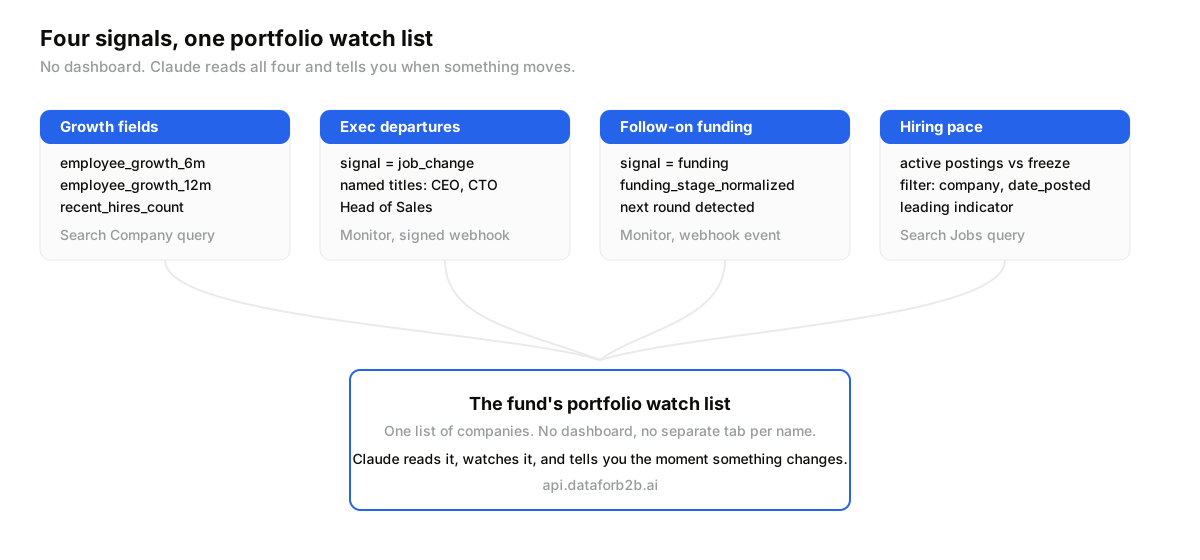
This is about the private companies your fund already wired money to. Growth. Executive departures. Funding rounds. Hiring pace. The signals that move between board meetings and never make it into a deck.
Claude, connected to a B2B data API, can watch all four across an entire portfolio list. It tells you the moment something changes, not the moment someone remembers to mention it.
Key Takeaways#
- Post-investment monitoring needs different signals than deal sourcing: growth, departures, funding, hiring pace, not thesis-fit.
- A single Search Company query can read growth fields across a whole portfolio list instead of opening each dashboard by hand.
- A job_change Monitor on named executive titles catches departures the moment a profile updates, via a signed webhook.
- Hiring pace from Search Jobs is a faster, cheaper leading indicator than the slower-moving growth fields.
Why Does Monitoring a Portfolio Company Need a Different Playbook Than Sourcing One?#
Portfolio monitoring is post-investment tracking that watches growth, departures, funding, and hiring at companies a fund already holds, not companies it might fund next. Sourcing looks forward for thesis-fit, while monitoring looks sideways for risk and the health of a bet already made.
The two moments in a fund's life feel similar. Both involve a list of companies and a set of signals.
But the questions are opposite. Sourcing asks if a company matches the thesis. Monitoring asks if a company is still healthy, and whether the fund is the last to know if it isn't.
Our own deal-sourcing agent guide sits on the sourcing side of that line. So does its Claude-specific sibling, how to source deals with Claude. This piece sits on the other side.
The good news: one primitive does both jobs. A Monitor watches a list. It fires on a signal. Sourcing points it at the open market. Monitoring points it at your own cap table.
How Do You Check Growth Across Your Whole Portfolio in One Query?#
You run a Search Company query across the fund's whole portfolio list, reading employee_growth_6m, employee_growth_12m, and recent_hires_count for every company in one pass. That beats opening a dashboard per name, or waiting on a founder update that may or may not still be current.
Most funds still check growth one tab at a time. LinkedIn here, a founder deck there, a spreadsheet nobody updates.
A single query against a B2B data API collapses that into one pass.
Problem: a seed fund with fifteen portfolio companies wants a Monday read on who is scaling and who has gone quiet. Before the partner meeting, not after.
Proof: the analyst runs Search Company against the fifteen company domains. One request. It pulls employee_growth_6m, employee_growth_12m, and recent_hires_count for all fifteen.
Eleven show positive growth. Two are flat. Two show negative growth with zero recent hires, worth a call before the meeting.
Payoff: the analyst walks in with a ranked list. Not a hunch. The two flat companies get a founder check-in that week. Not next quarter.
Here is roughly what that query shape looks like.
POST https://api.dataforb2b.ai/search/companies
Headers: { "api_key": "YOUR_api_key" }
Body: {
  "filters": {
    "domain": { "operator": "in", "value": ["company1.com", "company2.com"] },
    "employee_growth_6m": { "operator": "<", "value": 0 },
    "recent_hires_count": { "operator": "=", "value": 0 }
  }
}
Swap the operator and the same query flips: everyone accelerating, ranked for the next LP update.
Why Is a Key-Executive Departure the Sharpest Risk Signal You Get?#
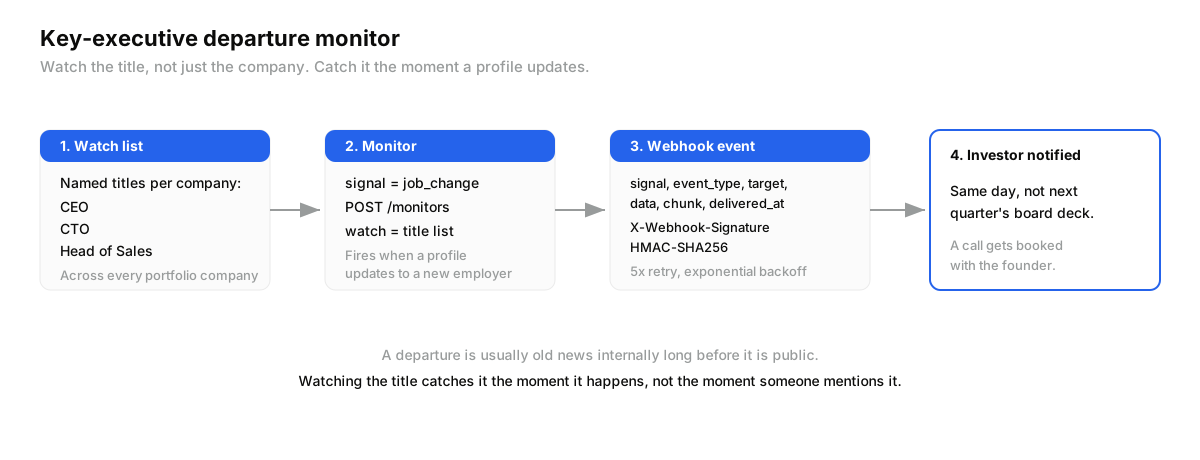
A key-executive departure monitor is a Monitor with signal=job_change watching named titles like CEO, CTO, or Head of Sales at each portfolio company. It catches the sharpest, most invisible risk signal an investor gets, because a departure is usually old news internally long before it is public.
Watching the company alone misses this. Watching the title catches it the moment a profile updates.
Problem: a Series A SaaS company in the portfolio has a CTO quietly talking to recruiters. Nobody at the fund notices until the founder mentions it in passing, three weeks later.
Proof: the fund sets a job_change Monitor on the CTO title (and CEO, Head of Sales) across the portfolio. When that CTO's profile updates, an event fires.
The envelope: signal, event_type, target, data, chunk, delivered_at. One object, delivered by webhook.
Delivery is signed with X-Webhook-Signature (HMAC-SHA256). It retries up to five times with exponential backoff.
Payoff: the operating partner has a call booked with the founder the same day the change goes public. Not the same quarter.
Following the Money: A Funding Monitor Pointed at Your Own Portfolio#
A follow-on funding monitor is a Monitor with signal=funding watching the fund's own portfolio company list. Not the open market. It turns a portfolio company's next round into a webhook event, not a line buried in next quarter's LP letter.
This reuses the same funding signal covered in our piece on tracking company funding signals. That guide points the signal outward, at companies you might invest in.
Here it points inward, at companies you already own.
The use case differs too. Outward, you race to get into a round. Inward, you want to know fast enough to congratulate the founder, or decide whether to follow on.
Set the Monitor once, on the full portfolio list. It fires per company, per round, tagged with the funding_stage_normalized value.
Lagging vs Leading: Where Does Hiring Pace Fit?#
Hiring pace, read through a Search Jobs query filtered by company and date_posted, shows active postings against a freeze. It moves faster than growth fields like employee_growth_6m, because postings shift weekly while headcount data only settles over months.
Growth fields are lagging indicators. They confirm a trend after months of headcount data pile up.
Job postings and job changes are leading indicators. They move before the headcount numbers catch up.
Decision criteria for which to check, and when:
- Use growth fields for a quarterly-feeling health check, once a month, across the whole portfolio.
- Use Search Jobs per company when a founder update feels vague and you want a faster read.
- Use job-change alerts for named risk. Not general health. They only fire on a specific person.
- Use all three together. None of them alone is proof of anything.
Zero active postings for two months, next to flat six-month growth, is a pattern worth a direct question. Neither signal alone tells you why.
What Portfolio Monitoring With Claude Is NOT#
This is a signal layer. Not a source of truth. The boundaries are worth stating plainly before anyone relies on it. A growth chart or a job alert only ever tells part of the story a fund needs.
- Not a replacement for board reporting or audited financials. Directional, not certified numbers.
- Not a relationship or CRM tool like Affinity. It does not track calls, notes, or intro history.
- Not a guarantee of anything. A growth dip or an executive departure needs a human read first.
- Not a dashboard. It pushes events. Someone still has to read them and decide.
How Do You Run This Workflow in Claude?#
You connect Claude to the data source through Settings, then describe the workflow in plain language: which portfolio list, which signals, which titles to watch. No API client and no script are required before the first Monitor is running.
Add the connector at Claude Settings, under Connectors, pointing to the DataForB2B MCP endpoint.
A prompt like "check growth for these fifteen domains and flag anything negative" runs the Search Company query behind the scenes.
A prompt like "watch these companies for CEO, CTO, and VP Sales changes" sets up the job_change Monitor. Same pattern for funding.
The MCP connector works the same way in any MCP-compatible agent. Not just Claude. Cursor or a custom agent runs the same workflow.
Most funds can stop here. Check the pricing page to see what a full-portfolio setup costs, free tier included.
A developer only becomes useful for piping webhook events into an internal tool at scale.
Portfolio monitoring is not glamorous work. Neither is finding out about a departure from a founder's farewell post. See how the VC data API plugs into Claude for your fund's own watch list. Or compare plans on the pricing page before the first Monitor.
Frequently asked questions
- How is monitoring a portfolio company different from sourcing a new deal with Claude?
- They sit at different points in the fund's lifecycle. Sourcing looks pre-investment, for thesis-fit. Monitoring looks post-investment, for risk and health. The same Monitor primitive serves both, just pointed at a different watch list with a different signal choice. The lifecycle changes; the underlying primitive does not.
- Can Claude tell me if a portfolio company is quietly struggling before the next board update?
- Combine flat or negative employee_growth_6m with a quiet Search Jobs read, meaning few or no active postings. Neither signal alone is proof of trouble. Together, they tend to show up weeks or months before a formal board deck reports the same thing.
- What happens the moment a portfolio company's CEO or CTO leaves?
- A job_change Monitor watching that named title fires an event the instant the profile updates, delivered by a signed webhook using HMAC-SHA256. That is why watching specific titles, not just the company as a whole, catches departures this early, before the news travels.
- Do I need engineering help to set this up as an investor, not a developer?
- No. Adding the MCP connector is a Claude Settings step, and monitors get created through plain-language prompts, not code. A developer becomes useful only once the fund wants to consume webhook events at real scale, across a large multi-company portfolio.
- Is this a replacement for Affinity or Crunchbase for portfolio tracking?
- Not exactly, and the two comparisons differ. Crunchbase is a funding directory built for browsing, and this data layer covers 800M+ profiles and 75M+ companies, broader than Crunchbase on people and contact data, plus it pushes live signals like job changes and funding instead of waiting on a lookup. Affinity is a different category: a relationship-graph CRM for tracking who knows who, which this does not replace.