10 Best B2B Data Enrichment APIs 2026, Ranked by Model
The best B2B data enrichment APIs 2026 offers, ranked: ten APIs scored on refresh model, published pricing, miss billing, plan gates and MCP access.
Every B2B data enrichment API returns a JSON object with a name, a title and a company. The differences that cost you money are somewhere else: when the record was last true, what a call costs when it returns nothing, and which plan unlocks the field you actually needed.
A builder on r/BuildAndScaleHQ put it better than any vendor page: "the response schema has cost me more grief than the match rate ever did." Another, on r/Data_Enrichment: "getting charged the same credit for a call that returns almost nothing as one that returns a fully populated record."
This ranking of the best B2B data enrichment APIs 2026 has to offer scores ten of them on those things. Published pricing, refresh model, billing on misses, plan gates and agent access, checked in September 2026. We build one of them and we are not first.
Key Takeaways#
- Ten APIs, three models: dataset vendors that refresh on a schedule, request-time APIs that fetch live, and waterfalls that call several of the others.
- Entry prices run from free to $98 a month, but the number that decides your bill is the plan that unlocks a work email, and it ranges from every plan to $499.
- Only four of the ten publish rate limits. Only three bill nothing on a miss.
- Every API here except two ships an MCP server, so agent access is now table stakes, not a differentiator.
How Did We Evaluate These APIs?#
We scored each vendor on six things a builder can check before signing: refresh model, entry price and what it buys, the plan that unlocks contact fields, whether a miss is billed, published rate limits, and whether REST is joined by MCP and webhooks. Coverage claims are quoted from the vendor. We did not run a match-rate benchmark, because a published match rate is an average across a population that is not yours.
We also asked the question Reddit keeps asking: is the schema stable between a full match and a partial one, and are nulls explicit. Where a vendor documents that, we say so.
The 10 Best B2B Data Enrichment APIs at a Glance#
| Rank | API | Model | Entry price | Work email unlocks at | Miss billed | Rate limits published | Access |
|---|---|---|---|---|---|---|---|
| 1 | Crustdata | Cached tier, gated live | $95/mo lowest tier | Enterprise | Search: noenrich: yes | Yes15, 10, 30 a minute | REST, MCP |
| 2 | People Data Labs | Dataset, batch | $98/moabout 350 records | Pro plan | Yes | Per plan | REST, flat files |
| 3 | DataForB2B | Request-time | Free tier$49 for 3,000 credits | Every plan1 credit | Search: on results only | Ask before a large batch | REST, MCP, webhooks |
| 4 | Prospeo and FullEnrich | Contact waterfall | Free credits | Every plan | Nopay on verified | Per plan | REST |
| 5 | Coresignal | Dataset plus credit API | $49/mo2,500 credits | Pro plan, $499 | Yes | Yes5 a second on Mini | REST, MCP, flat files |
| 6 | Apollo.io | Platform database | Free$49 per user annual | Includedup to 9 credits | Only on qualifying data | Yes50 to 200 a minute | REST on Custom, MCP |
| 7 | Clay | Waterfall orchestrator | FreeLaunch $167/mo annual | Via providers | Per provider | Per provider | HTTP API on Growth, MCP |
| 8 | Explorium | Prepaid packs | $99.99 one-timeexpires 12 months | Included | Yes | Per plan | REST, MCP |
| 9 | Breeze Intelligence | Inside HubSpot | About $45/mo for 100 creditsplus HubSpot | Included | Yes | HubSpot limits | HubSpot workflows |
| 10 | Hunter | Finder and verifier | Freepaid tiers | Every plan | Finder: on result | Yes | REST |
Scroll sideways for every column
The order is ours and it is arguable. Crustdata is first because its cached search is the cheapest discovery in the category and its filters are the ones builders praise most. PDL is second for coverage and entity resolution. We put our own API third, behind both, because the ranking is about the category and a vendor that ranks itself first has told you what the list is for.
Which API Fits Which Job? The 10 in Detail#
Each entry below states the model, the published price, the gate and the fit in the same order, so a builder can read the ten in a row and rule out the ones whose meter is wrong before comparing features.
1. Crustdata: The Cheapest Discovery, Behind a Gate#
Crustdata is an API-first provider covering people, companies, jobs and social posts, with search priced at 0.03 credits a result and zero-result searches free. Cached person enrichment runs 1 to 7 credits additive. Live people endpoints, contact enrichment and social posts sit on plans that start with a sales conversation, and the lowest tier is $95 a month.
Best for cheap cached discovery and technographics on company records. The gate is the price: what most self-serve builders need daily, live fetch and a work email, sits on plans they do not have. Credits expire six months after purchase. Our Crustdata comparison has the full table.
2. People Data Labs: The Dataset Workhorse#
People Data Labs sells a copy: 3B+ person records with strong people-to-company resolution, refreshed on a batch cadence, from $98 a month for about 350 records on self-serve. The free tier returns 100 records with contact fields obfuscated. Bulk flat files sit on enterprise.
Best for warehouse-scale ingestion and market mapping. The complaint is freshness: "the monthly batch refresh is a problem for anything real time," as one r/AI_Agents user wrote. Filters on self-serve are basic. See the People Data Labs alternatives page for the full comparison.
3. DataForB2B: Live at Every Call, No Plan Gate#
It is a request-time API over 800M+ profiles and 75M+ companies: a cached search result is 0.75 credits, a live fetch 1.5, a verified work email 1, on every plan from the free tier up. Search runs on 60+ people filters and 40+ company filters including funding stage and headcount growth. Jobs, social posts with engagers, and job-change and funding webhooks sit next to it over REST, MCP and webhooks.
Best for agents that decide at request time and products that embed enrichment. There are no flat-file datasets to buy, so a 50-million-row warehouse job belongs elsewhere. Plans run $49, $150 and $450 a month. Grid on the pricing page.
4. Prospeo and FullEnrich: Pay Only When It Verifies#
Prospeo, FullEnrich and Findymail are contact waterfalls: they query several upstream sources for an email or a phone and charge only when the contact verifies. That billing model answers the loudest Reddit complaint directly, and users credit them with lower bounce rates.
Best as a top-up layer on a list you already have. They do not search, and they do not return the profile. Pair one with a search or dataset API.
5. Coresignal: Bulk With Credits on Top#
Coresignal aggregates 15+ web sources into 895M+ profiles and sells them as datasets and credit APIs from $49 a month for 2,500 credits. Collecting a record costs 10 to 20 credits, and contact enrichment opens at the $499 Pro plan at 20 credits. Jobs data is strong at 1 credit a posting.
Best for warehouse ingestion and headcount analytics over time. Expensive per record at self-serve tiers. Our Coresignal comparison runs the math.
6. Apollo.io: The Platform With a Database Inside#
Apollo is a finished sales application whose database is reachable by API on Custom plans. Pricing is per user from $49 a month on annual billing, enrichment burns up to 9 credits a record, and rate limits run 50 to 200 requests a minute with a 200-an-hour cap on most tiers.
Best for sales teams that want the sequencer and the Chrome extension. Users report 20 to 30 percent bounces on "verified" emails. As a data layer for an agent, the seat meter is the wrong shape. Full comparison in our Apollo API alternatives page.
7. Clay: The Orchestrator, Not the Source#
Clay is a waterfall workbench that chains 100+ providers in a table, with a free plan and Launch from $167 a month on annual billing. The HTTP API sits on the Growth plan. It is not a data vendor; it calls the vendors above and lets you write the routing.
Best for ops teams building custom enrichment logic. The learning curve is steep and credits are easy to burn, per Reddit. Wrong as a database, for the reasons in our Clay comparison for developers.
8. Explorium: Prepaid Packs for GTM Teams#
Explorium sells one-time data packs from $99.99 to $7,499.99 that expire after twelve months, with firmographic and partner intent signals, over REST and MCP. Built for GTM teams buying enrichment in bulk rather than builders wiring a product.
Best for a marketing team with a quarterly budget and a defined list. The expiry and the non-refundable packs are the trade-off. See the Explorium comparison.
9. Breeze Intelligence: Clearbit, Inside HubSpot#
Breeze Intelligence is what Clearbit became after the HubSpot acquisition: enrichment and buyer intent inside HubSpot, from about $45 a month for 100 credits on top of a paid HubSpot plan. Standalone API access is closed to new customers.
Best for teams whose CRM is HubSpot. Everyone else has to migrate, and our Clearbit API alternatives page is the plan.
10. Hunter: The Verification Layer#
Hunter finds and verifies email addresses with a free tier and published limits. The database is small next to the others on this list, and Reddit calls it a verification layer rather than a primary source.
Best as a final check before send. Not a search, not a profile.
Dataset, Request-Time or Waterfall: Which Model Fits Your Pipeline?#
The model matters more than the vendor. A dataset gives you a copy you refresh on a schedule and query locally, which fits analytics and bulk. A request-time API answers each call live, which fits agents acting at a moment. A waterfall calls several sources per record, which fits coverage gaps at the cost of maintenance. Pick the model, then the vendor.
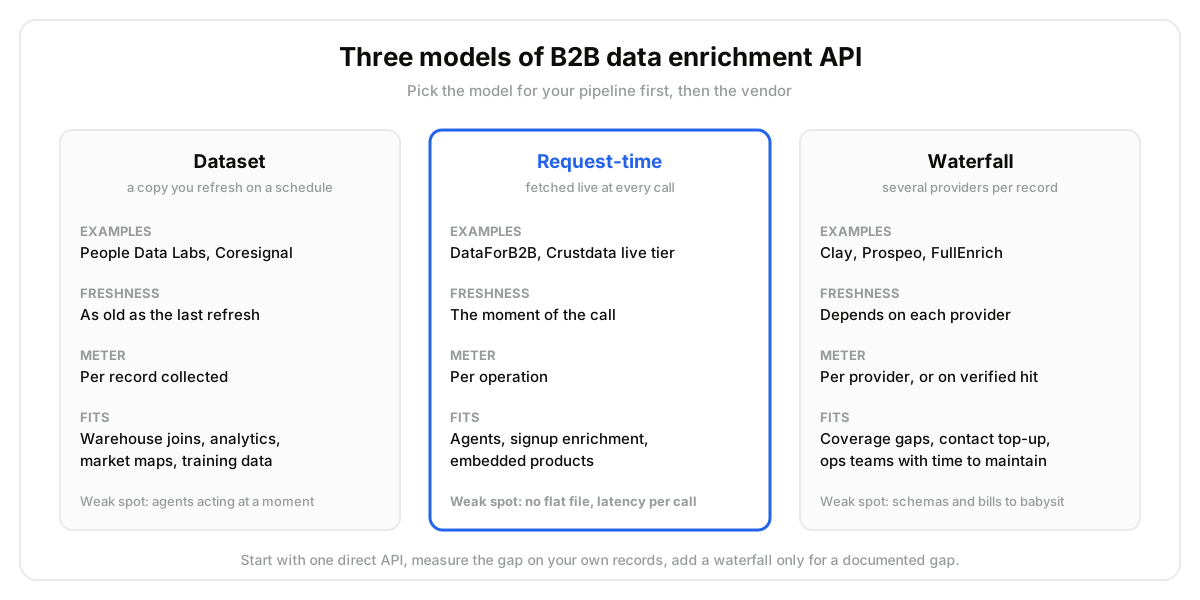
A small team on r/BuildAndScaleHQ described the trade-off honestly: start with one direct API, measure where it fails on your own records, and only add a waterfall layer once you can point at a documented gap. Adding the complexity before proving the gap is how small teams end up maintaining infrastructure they never needed.
How Do You Run This Test in Claude?#
You run it by sending the same 100 records to two or three of the APIs above on the same day, from one conversation, and scoring current employer accuracy, contact fill rate, cost on the plan the volume forced you onto, and how the schema behaved on partial matches.
- Create a free account on app.dataforb2b.ai/signup and pull an API key. Sign up for the free tiers of one dataset vendor and one waterfall.
- Connect the MCP server in Claude under Settings, then Connectors, at https://mcp.dataforb2b.ai/mcp. The same server works with Cursor, VS Code, ChatGPT and any MCP-compatible agent.
- Paste the prompt: "Take these 100 contacts, refresh each one's current company and title, add a verified work email where one exists, record which fields came back null on each provider, and flag every record where the two providers disagree on the employer."
- Turn it into a scheduled routine, weekly, so the freshness comparison covers a month of real changes.
The disagreements are the result. They tell you which provider's copy is older, and on which segment of your list, which no published match rate ever will.
No single API is best. There is a model that fits your pipeline and a vendor that fits your segment. Run the 100-record test, read the disagreements, and start on the free tier on the pricing page if the answer is request-time.
Frequently asked questions
- What is a B2B data enrichment API?
- A B2B data enrichment API is a service that takes an identifier you already have, an email, a domain or a profile URL, and returns structured professional data about the person or company: title, employer, headcount, funding, contact fields. It differs from a search API, which finds people you do not yet have, though several vendors offer both.
- Which B2B data enrichment API has the freshest data?
- Request-time APIs, which fetch at the moment of the call, return the current employer rather than a stored one. Per-operation APIs and Crustdata's live tier work this way. Dataset vendors like People Data Labs and Coresignal refresh on a schedule, so a job change between refreshes is invisible until the next run. A public test by 42agency found cached sources still returning a stale employer two weeks after a move.
- Do enrichment APIs charge for failed lookups?
- Most charge per call regardless of what comes back, which is the most common complaint on Reddit. Contact waterfalls like Prospeo and FullEnrich charge only on a verified hit. Crustdata's search is free on zero results. Per-operation APIs bill search per result returned. Ask every vendor this question before you sign, and check it with a dead profile URL.
- What is the cheapest B2B data enrichment API?
- On entry price, several have free tiers: Apollo, Clay, Hunter, the contact waterfalls and the request-time API ranked third. On cost per useful record the answer changes with your workload: Crustdata's 0.03-credit search is cheapest for discovery, and a per-operation API at 2.5 credits for a live profile plus work email is cheapest for fresh contact records. Price the workflow, not the entry tier.
- Do these APIs work with Claude, Cursor and AI agents?
- Eight of the ten publish an MCP server, so an agent in Claude, Cursor or a custom stack can call them as native tools. Breeze Intelligence runs inside HubSpot, and Hunter is REST only. The meter does not change through MCP: the account behind the connector still pays per the plan, and gated endpoints stay gated.