How to Find Companies Hiring With Claude (2026 Guide)
Learn how to find companies hiring with Claude: chain Search Jobs, Search People, and Enrich Profile into verified sales contacts before the role fills.
A company opens three backend engineer roles in the same week. That is not a hiring spree. That is a budget signal with three job posts as proof.
You may have typed "how to find companies hiring with Claude" hoping to scan job boards for your own next role. This guide is not that. The two meanings look identical in a search bar. They are not identical in practice.
This one is for sales and GTM teams. This one covers how to find companies hiring with Claude, connected to a live jobs source. Then it shows how to turn that signal into a decision-maker's work email, before the role gets buried in a list.
Two workflows do the work. One reads job postings. The other reads the social posts that show up before those postings even land.
Key Takeaways#
- A job posting is a growth signal, not a to-do list for job seekers.
- Search Jobs finds the posting, Search People finds the decision-maker, Enrich Profile finds the email.
- Search Social Posts catches hiring announcements the same day, often before a job board does.
- Multiple concurrent postings plus positive employee_growth_6m separate real expansion from backfill.
Which Hiring Signals Actually Predict a Sales Opportunity?#
A hiring signal is a data point that flags budget, exposes a pain point, and times an outreach window. A single job posting can mean anything. Three postings for the same function in one week rarely mean nothing. The pattern is the signal, not any one post.
Recruiters open reqs for growth, backfill, or a new initiative. Sales teams only care about the first one.
A company data API turns scattered postings into a queryable list instead of a feed you scroll by hand. That list is only useful if it's structured: filterable by role, date, location, and company.
Without structure, hiring activity is just something you notice by accident on someone's profile.
Think of it as a filter on top of noise. Most job posts have nothing to do with growth. A few do, and those are the ones worth a query. Not noise. Signal.
How Do You Turn a Live Job Posting Into a Verified Contact?#
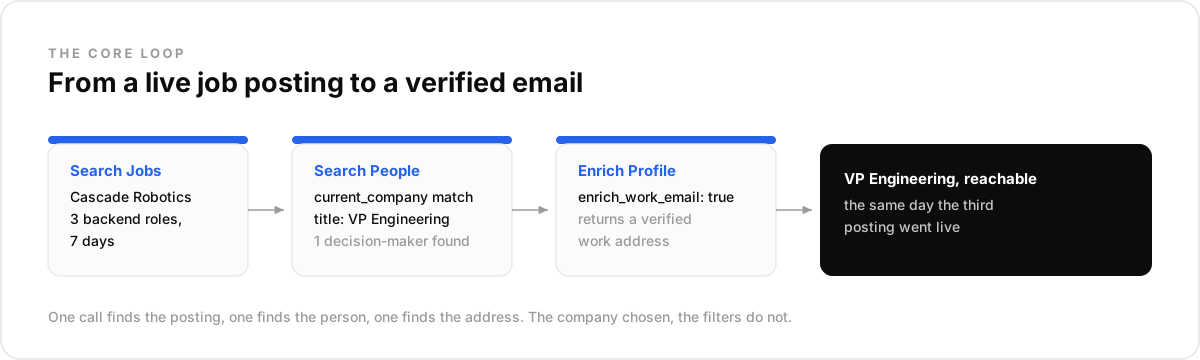
You chain three calls. Search Jobs finds the posting and the company behind it. Search People filters that company for the right title. Enrich Profile turns the match into a work email you can send to today. No manual list-building step.
Problem: you track two hundred target accounts and no way to know who just got new budget.
Proof: Cascade Robotics posts three backend engineer roles in seven days. A Search Jobs call with date_posted set to past_week catches all three the same day. Search People filtered on current_company Cascade Robotics and current_title containing "VP Engineering" surfaces one match. Enrich Profile with enrich_work_email set to true returns a verified address.
Payoff: a contact card with the reason for the email already written into it.
POST https://api.dataforb2b.ai/search/jobs
Headers: api_key: YOUR_API_KEY

{
  "keyword": "backend engineer",
  "company": "Cascade Robotics",
  "date_posted": "past_week",
  "seniority": ["senior", "mid_senior"]
}
One detail matters here. Target the hiring manager, not whoever posted the req.
A recruiter posted it. A VP Engineering owns the budget behind it.
Run this against one target account before scaling it. See the plans that fit a smaller test batch first.
What Catches a Hiring Signal Before the Job Board Does?#
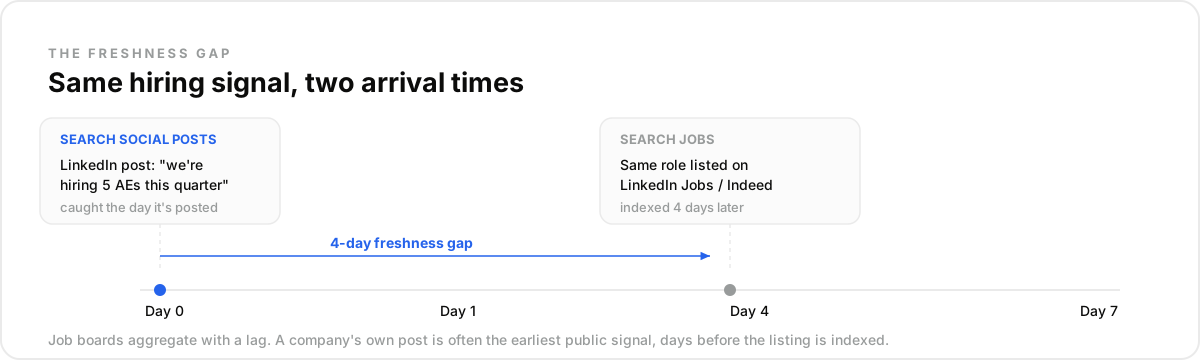
Search Social Posts reads LinkedIn, Twitter, and Reddit for hiring language: "we're hiring," a specific title, a headcount milestone. Job boards aggregate with a lag of a few days. A company's own post about a new hire or an open role is often the earliest public signal available.
Problem: by the time a role hits a job board, other vendors already found it.
Proof: Ledger Peak Financial's VP of Sales posts on LinkedIn about opening five account executive seats this quarter. A Search Social Posts call, platform linkedin, keyword "we're hiring," filtered on author_company, catches the post that same day. The matching listing does not appear on a job board for another four days.
Payoff: four days of outreach room nobody else used yet. Same day. Not four days later.
Job Postings or Social Signals: Which Should You Trust First?#
Neither wins outright. Job board data (Search Jobs) covers more roles with a normalized schema and structured filters, but arrives with lag. Social posts (Search Social Posts) arrive faster, sometimes same-day, but carry more noise and no guaranteed structure. Use both, at different points in the same funnel.
- Need broad coverage across many roles and companies? Start with Search Jobs.
- Need to catch a signal same-day, before it's indexed anywhere? Add Search Social Posts.
- Chasing one title at one account? Search Jobs plus Search People is faster.
- Watching a whole target list for any hiring activity? Run both on a schedule.
Two sources. One funnel.
That trade-off differs from a slower check like tracking company headcount growth. That approach reads an aggregate stat updated over months.
This one reads a single role, live, sometimes the same day it opens.
What This Workflow Is Not#
This is not a job board for people looking for their next role. It is not the same as a general headcount or growth stat pulled once a quarter. And it is not proof that every posting means new budget. Backfill happens. Read the pattern, not just the ping.
- Not a job-seeker tool. It is built for outbound targeting, not applying.
- Not a substitute for a growth stat like employee_growth_6m, which measures a trend, not a role.
- Not a guarantee of budget. A posting can just be a backfill for someone who left.
Confirming Real Growth Before You Reach Out#
One more check keeps a list honest. Search Company exposes employee_growth_6m and recent_hires_count for the same account. Positive growth alongside three open roles in one function reads as expansion. Flat or negative growth alongside a single posting reads as a replacement hire.
This check works well as a tiebreaker. If two accounts both show three open roles, the one with higher employee_growth_6m is probably worth calling first.
- Best for: an account with multiple concurrent postings in one function.
- Not for: a single quiet requisition with no other hiring activity nearby.
Run the same check against your top twenty accounts this week. A free tier covers a test batch before you commit further.
How Do You Run This Workflow in Claude?#
Connect Claude to DataForB2B through Settings, then Connectors, using the MCP endpoint at mcp.dataforb2b.ai/mcp. From there, ask Claude in plain language. Find backend engineer postings from the past week. Then find the VP Engineering at each company, and get a work email for each match.
The same connector works in any MCP-compatible agent: Cursor, VS Code, ChatGPT, or a custom build, not just Claude.
Prefer to automate it end to end? Call the REST endpoints directly against api.dataforb2b.ai with an api_key header instead of chatting through Claude each time.
A second prompt might read: check employee_growth_6m for the same company before you send anything.
This mirrors a broader pattern: finding B2B leads with Claude more generally, just filtered through hiring activity instead of firmographics alone.
Hiring activity is one of the few signals that tells you exactly who has budget and roughly when. Connect a live jobs and social source to Claude, or call DataForB2B's REST API directly. Turn that signal into a contact before it goes cold. Compare plans and start with one target list this week.
Frequently asked questions
- Can Claude tell me which companies are hiring right now?
- Not on its own. Claude has no live job database built in. It needs a connected source, through MCP or the REST API, like Search Jobs pulling from LinkedIn and Indeed. Without that connection, Claude is guessing from stale training data instead of reading a current posting.
- Is a job posting a reliable sales signal, or just noise?
- One posting alone can be a backfill for someone who left. Multiple concurrent postings in the same function are a stronger signal. Pair that pattern with positive employee_growth_6m and it starts to look like real expansion, not a replacement hire.
- How fresh does the hiring data need to be to matter?
- It depends on the play. Use date_posted filters, past_24h, past_week, past_month, alongside the days_since_posted field on each listing. Past-week fits time-sensitive outbound work. Past-month fits broader list-building. A same-day social post can still beat both windows, if you catch it before the moment passes.
- Can Claude go straight from a job posting to a contact I can email?
- Yes. Chain Search Jobs into Search People, filtered on the hiring company and a relevant title, then into Enrich Profile for a work email. Target the hiring manager, not the person who posted the req. That's usually a recruiter, and rarely the right contact.
- What's the difference between tracking headcount growth and tracking live job postings?
- Headcount growth (employee_growth_6m) is a lagging, aggregate trend measured across months. A live job posting, or a "we're hiring" social post, is role-specific and near real-time. Pairing both catches different moments inside the same expansion instead of relying on just one view.