How to Detect B2B Buying Signals with Claude (2026 Guide)
Learn how to detect buying signals with Claude: funding, job changes, hiring velocity and social asks via webhooks and search, plus the two-signal rule.
Search "how to detect buying signals with Claude" and half the results are about trading. This is not that. This is about B2B buying signals: a company raises, a champion changes jobs, a team posts six engineering roles, a founder asks Reddit for a tool. Each one is a window. Most of them close within weeks.
Claude can watch all of them at once, but only if the signals arrive as data it can act on. A webhook for the events, a search for the context, an email at the end. This guide shows the setup and the scoring rule that keeps the agent honest.
Key Takeaways#
- A B2B buying signal is an observable event, not a score someone sold you. Funding, job changes, hiring velocity, and social asks are the four that pay.
- Claude gets them two ways: webhooks for live events, search for context. One monitor per signal, one search per account.
- Act on two signals, never one. A round plus hiring beats a round alone.
- The hottest signal is a person asking for a solution in public. Enrich that author first.
What Is a B2B Buying Signal?#
A B2B buying signal is an observable event that shows a company or person is about to spend, hire, or switch, such as a funding round, a job change, a burst of hiring, or a public request for a tool. It is timing data. It tells you when, not just who.
Timing is the part most lists lack. A signal says something changed this week, and the pitch that references the change lands while the buyer still remembers it.
Four signal families carry most of the weight in outbound, and each one is a data call away:
- Funding. A round closed, and a budget landed on someone's desk. Runs hottest in the first quarter after the raise.
- Job change. A decision-maker moved. New leaders replace tools in their first 90 days.
- Hiring velocity. Six open roles in a function means that function is about to grow and buy.
- Social asks. Someone posted "anyone know a tool for X". They are shopping right now.
What Buying Signals Are Not#
Buying signals are events you can point to, not inferred scores or anonymous traffic. Three neighbouring products get lumped in with them, and the difference matters because it changes what Claude can verify, what a rep can be shown, and what the agent is allowed to act on without a second check.
- Not web intent data. Bombora or 6sense sell topic scores modelled from content consumption across a co-op. Useful for ads, but nobody can show you the event behind the number.
- Not website de-anonymisation. RB2B tells you a company visited your pricing page. One r/gtmengineering thread called it a needle in a haystack. A hint, not a trigger.
- Not a static lead list. A list built last quarter has no timestamp. Signals are the timestamps.
How Does Claude Receive Signals in Real Time?#
Claude receives live signals through monitors: you create one per signal type with a watch list and a webhook URL, and events arrive as they happen. The signal catalog covers job change, funding, founder moves, and post engagement. No polling, no nightly export, no table to refresh.
A monitor is three fields. The signal, what to watch, and where to send it.
POST /monitors
api_key: YOUR_api_key
{
  "signal": "funding",
  "watch": ["https://social.com/company/acme", "https://social.com/company/globex"],
  "url": "https://your-server.com/webhooks/signals"
}
Every event lands in the same envelope: the signal name, an event type, the target it fired on, the data payload, and a delivery timestamp. Requests carry an HMAC signature so your endpoint can verify them, and failed deliveries retry five times with backoff.
Claude reads the payload, pulls the company through a search for context, checks for a second signal, and either drafts an opener or files the event. The webhook is the trigger. Claude is the judgment.
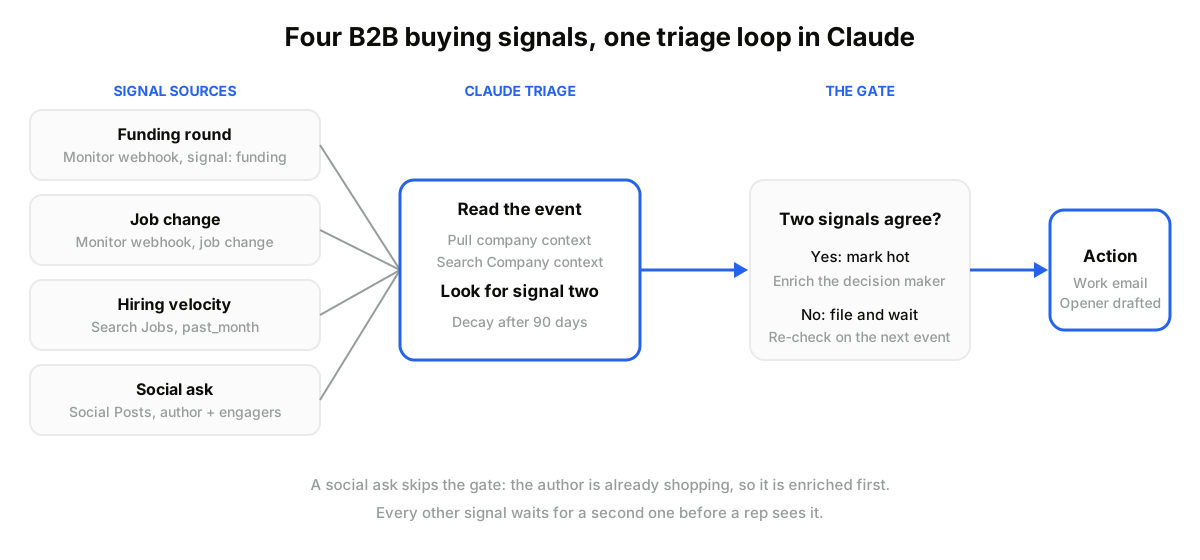
If you already track one of these alone, the same pattern extends it. The job-change flow in how to track job changes with Claude and the funding flow in how to track company funding signals both become inputs here.
Why Should Claude Wait for Two Signals?#
Claude should act only when two independent signals agree, because any single source is stale or wrong often enough to burn a rep's morning. A funding round from four months ago plus zero hiring is a company sitting on cash. A round plus twelve open roles is a company in motion.
The mistake most teams make is firing on the first event. One practitioner who built an inbound scoring skill on Claude put it plainly on Reddit: do not trust a single enrichment source for size or funding stage, cross-check at least two signals, and treat a recent round plus real hiring velocity as the pair that matters, because how recent the round was counts for less than whether they are moving right now.
Here is the cross in practice. Search Jobs takes a keyword, seniority, and a date window, and returns each posting with its function and days since posted. Search Company returns last funding date, funding stage, and six-month employee growth for the same account. When we tested this on 800 accounts, the two calls disagreed constantly. That disagreement is the filter.
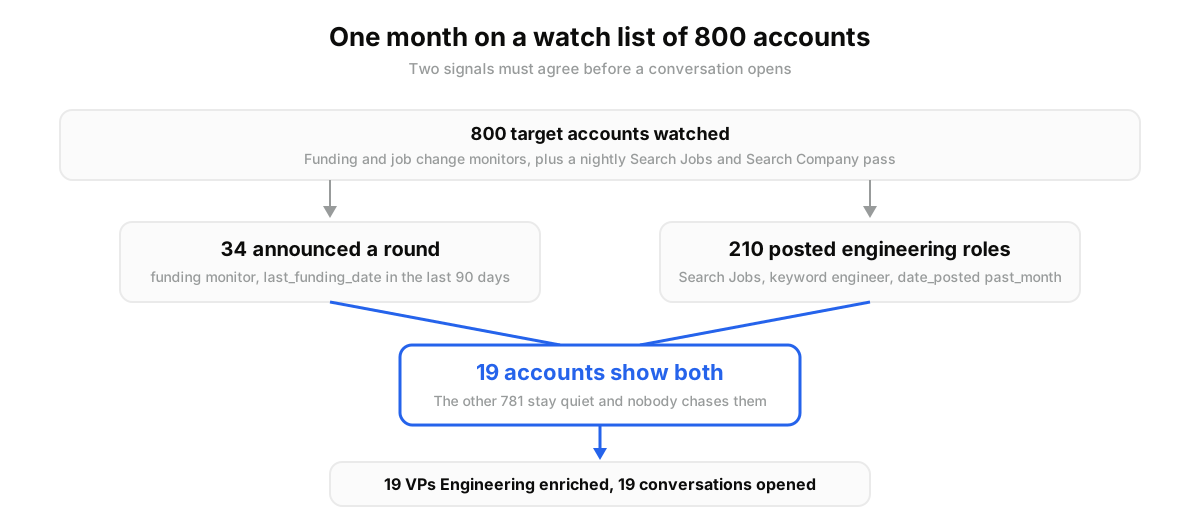
Proof. An SDR agent at a 20-person devtools startup in Austin watches 800 target accounts. In one month, 34 of them announce a round and 210 post at least one engineering or platform role. Only 19 accounts show both. The agent enriches the VP Engineering at those 19 for a verified work email and opens 19 conversations. The other 781 stay quiet, and nobody on the team chases a raise with no hiring behind it.
Start on the free tier on the pricing page and point this at your own watch list.
Which Signal Is Hotter Than Funding?#
A person publicly asking for a solution is hotter than any funding event, because the intent is explicit and the buyer is named. Search Social Posts finds those asks across LinkedIn, X, and Reddit, and returns the author and everyone who engaged as leads. The author goes first.
The query is a phrase, not a company. "Looking for a data enrichment API", "anyone using an AI SDR", "recommendations for a candidate sourcing tool". Match strict for precision, loose for reach, past week for freshness, and a subreddit when the community is known.
Two lead types come back: the author, who is shopping, and the engagers, attached with include reactions and comments. Enrich the author for a work email first. Queue the engagers behind.
Proof. A two-rep team selling a recruiting API watches r/recruiting and LinkedIn for "sourcing tool" asks. In a week the search returns 14 posts. Three authors are heads of talent at 200 to 500-person companies. The agent enriches the three, drafts a reply that answers the question they asked, and only then mentions the product. One founder described the outcome in a thread: the reply that answered the actual question got a meeting, the pitch that ignored it got nothing.
Funding still matters. The round to decision-maker to email chain runs alongside hiring every day. Social asks just jump the queue when they appear.
How Do Signals Differ by Vertical?#
The same four signals feed three different agents, and the difference is which one triggers and who gets enriched. Sales acts on funding plus hiring. Recruiting acts on hiring and job changes. Investment acts on founder moves and funding. The plumbing is identical.
- Sales. An outbound agent waits for a Series A plus three RevOps postings, then finds the new VP Sales and opens on the raise.
- Recruiting. A sourcing agent watches for engineering managers who just changed jobs, because new managers hire their old team.
- Investment. A deal-sourcing agent watches for an exec leaving a top company with no new role listed, and catches the stealth founder before the announcement.
Best for: teams whose agent already has an ICP and needs timing on top of it. Not for: a team with no target list yet. Build the list first, following how to build a signal-based prospecting list, then add detection.
The trade-off: you give up the tidy score a web-intent vendor hands you, and you get events you can show a rep when they ask how the agent knows. DataForB2B exposes all four through one key, which is what makes the cross cheap enough to run daily.
How Do You Run This Workflow in Claude?#
You run it with one data connection, one prompt, and one schedule. Claude gets the search and monitor tools through MCP, you describe the watch list and the two-signal rule in plain English, and a routine reruns it each morning. Setup takes about ten minutes.
- Create a free account at app.dataforb2b.ai/signup and copy your API key.
- In Claude, open Settings, then Connectors, and add the MCP server at https://mcp.dataforb2b.ai/mcp. The same server works with any MCP-compatible agent: Cursor, VS Code, ChatGPT, or a custom build.
- Paste the prompt: "Watch these 800 accounts. Each morning, list companies with a funding event in the last 90 days that also posted 3 or more engineering roles in the last 30 days. For each, find the VP Engineering, get a verified work email, and draft a two-line opener that references the round and the roles. Skip anyone we contacted in the last 60 days."
- Turn the conversation into a scheduled routine, in Claude Cowork or as a Claude Code routine, and create funding and job-change monitors pointing at your webhook so events arrive between runs.
You are probably thinking this needs an engineer. It needs one API key and a prompt you have read twice. See how the DataForB2B data layer fits your agent on the pricing page.
Signals only pay when something acts on them the same day. Give Claude the events and the search, hold it to two signals, and let it open the conversations. Grab an API key on the pricing page and run the first morning tomorrow.
Frequently asked questions
- What counts as a B2B buying signal?
- Any observable event that shows a company or person is about to spend, hire, or switch. The four that convert most reliably are a funding round, a decision-maker changing jobs, a burst of hiring in one function, and a public post asking for a tool. Modelled intent scores are inferences, not signals.
- Can Claude monitor buying signals in real time?
- Yes, through monitors. You create one per signal type with a watch list and a webhook URL, and job change, funding, founder move, and post engagement events arrive as they happen. Claude reads each envelope, pulls context through search, and decides whether to act. No polling or nightly export is involved.
- Which buying signal is the strongest?
- A person publicly asking for a solution, because the intent is explicit and the buyer is named. After that, funding is the top-tier signal, strongest in the first quarter after the round. Both get stronger when paired with hiring velocity, which proves the company is in motion rather than sitting on cash.
- How do you score buying signals with Claude?
- Give Claude a rule, not a formula. Require two independent signals before an account is marked hot, weight funding and social asks above the rest, and decay every signal after 90 days. Persist the score and the reason somewhere queryable so you can audit why a lead was routed and tune the weights later.
- Do you need a CRM to use buying signals?
- No. The workflow runs on a watch list, a webhook endpoint, and Claude. A CRM helps when you want the events written back to accounts and suppression lists respected, but a spreadsheet or a small database does the job for a team of two. Add the CRM sync when the rep count grows.